

- MLOps North
- Toronto Summit
- Presented by TMLS
Building<with>Agents
And the people building <with> them — one room, on the Toronto waterfront.
- 2026
- RBC WATERPARK PLACE

Ship-it-Monday patterns
Every session is a working practitioner walking through what they run in production — architecture, failure modes, and the fix.
Both sides of the agent stack
Whether you build the frameworks or build on them, you’re in the room with the people solving the problem one layer over.
The Toronto AI network, in person
Cohere, Vector, RBC, Shopify, Wealthsimple and the startups between them — two days on the waterfront.
Two parts: The stack and what you ship on it
What you ship on it — products, workflows, and agents in regulated industries. Living with what happens next.
Tracks & track leads
7 tracks · each curated by its lead
Evals and Benchmarks
In a world where models are released daily, how do we build an effective eval approach, or know when the right time is to swap models? This session is designed to help engineers move more quickly, build better products, and save on costs

VP AI Engineering, Vector Institute
AI Sovereignty
Running your own AI stack became an urgent question after the temporary deprecation of Anthropic’s Mythos, but not every workload should move, and this track is as much about deciding well as about migrating.

Co-Founder, Peerlabs
Agent Memory Architectures
There is no settled architecture for deciding what an agent should store, retrieve, revise, and forget. In this track, attendees will leave with a stronger understanding for choosing, implementing, and evaluating memory components in an agent system.

Co-Founder & CTO, Hudson Labs
Cost Management and ROI
AI usage continues to grow, yet leaders are struggling to quantify the ROI of their investment. In this track you’ll hear from engineers who have debugged and optimized their costs.

SVP AI & Operations, Wisedocs
Recursive Self-Improvement
AI systems can increasingly self-evaluate and modify their own prompts, tools, memory, code, data, and workflows. This track will focus on ensuring these feedback loops produce genuine, repeatable improvement rather than benchmark overfitting or unstable changes.
Co-Founder & CTO, Hudson Labs
Coding Agents & Dev Workflows
Being more productive than you were before coding agents makes it easy to be fooled into thinking you’re already at best practice. This track covers coding agents on complex codebases, secure AI-assisted development, and the code review bottleneck with concrete case studies from speakers who’ve gone beyond the hype.
Co-Founder, Peerlabs
Big Ideas, Innovations, Creative Explorations
The field of AI is moving at breakneck speed, and while teams race to capture value, the biggest opportunities often lie with big, bold ideas and creative, outside-the-box approaches

Founder TMLS, MLOps World
Agent Deployment & Observability
Founder TMLS, MLOps World
Practitioners walking through what they actually run.

Kathryn Hume
VP AI Engineering
Vector Institute
Kathryn Hume
About the Speaker:
Kathryn Hume leads AI Engineering at the Vector Institute, where she builds tools and platforms that further industry adoption of frontier AI. Prior to joining Vector, she held multiple technology leadership roles in financial services and AI, including Chief Technology Officer for Tangerine Bank, Vice President of Technology for RBC’s mobile, online banking, and direct investing businesses, and Interim Head of Borealis AI, RBC’s AI research institute. Before joining RBC, she held leadership roles at AI startups integrate.ai and Fast Forward Labs (acquired by Cloudera).
Kathryn is a recognized author and public speaker, with work appearing at TED, the Harvard Business Review, and the Globe & Mail. She has served as a guest lecturer and adjunct professor — teaching courses on applied AI and responsible AI — at the Harvard Business School, Stanford, the University of Toronto, and the University of Calgary. She is a mother of two young boys, a board member at CanadaHelps active in the charity sector, and an advocate for women in technology and educational reform in the age of generative AI.
Talk Title:
Track:
Sub Topic:
Abstract:

Wendy Foster
Principal Data Scientist
Disco
Wendy Foster
About the Speaker:
Wendy is a principal data scientist at Disco, a Toronto based educational technology startup. She has over a decade of experience building data products and teams at scale. Previously, she has held data leadership positions at Shopify, PagerDuty, and Wattpad.
Talk Title:
Track:
Sub Topic:
Disco’s MCP server lets learning operators and administrators manage and generate insight about their programs through AI agents instead of dashboards, which means those agents need to be trustworthy, not just capable. This talk walks through how we built our eval process for MCP tools, from defining what ‘correct’ looks like for operator-facing actions to structuring a dataset that catches failures before operators do.
What You’ll Learn:
Most organizations building on MCP are still treating it like a plumbing problem (get the tools connected, ship it) without a rigorous way to know whether the agent is actually doing the right thing when it touches real operator data and workflows. This talk gives practitioners a concrete, repeatable process for building evals that catch agent failures before they reach production, using a real multi-phase MCP rollout as the case study.

Erin Li
Head of AI Research
CIBC
Erin Li
About the Speaker:
Head of AI Research at CIBC, with twelve years at the financial sector spanning every stage of the path research must travel to become value. Erin set her research priorities with business accountability, production relevancy, and clear governance, so frontier work is scoped from the outset against what institutions can operationalize, govern and monetize.
Talk Title:
Track:
Sub Topic:
Abstract:
Most AI benchmarks are optimized for public datasets and generic tasks, but enterprise teams operate in a very different reality: domain-specific workflows, regulated data, multimodal inputs, and business-critical quality thresholds. This talk presents the CIBC Benchmark, an enterprise evaluation framework designed to test AI models and workflows against real enterprise tasks, enterprise-relevant datasets, and standardized evaluation metrics.
What You’ll Learn:
- A simple but scalable way to structure enterprise AI benchmarking
- A framework that works across models, prompts, tools, and end-to-end workflows
- A better method for connecting benchmark design to real business use cases
- A way to make evaluation results more useful for deployment and governance decisions
- A more mature view of performance that includes not only correctness, but also speed, cost, and consistency

Devinder Kumar
Head - ML Systems & Engineering
TD Bank
Devinder Kumar
About the Speaker:
ML engineering leader bridging cutting-edge research and enterprise-scale production. Currently leading ML Systems & Engineerg group at TD Bank (AI Platform).
I am passionate about building high-performance teams & delivering AI solutions that make a difference. Academic foundation includes a PhD in Machine Learning from UWaterloo and a Postdoctoral Fellowship at Stanford.
Talk Title:
Track:
Sub Topic:

Diederik van Liere
Chief Technology Officer
Wealthsimple
Diederik van Liere
About the Speaker:
Diederik van Liere is the Chief Technology Officer at Wealthsimple,Canada’s leading financial innovator serving more than 4 million Canadians and holding approximately $155 billion in assets under administration as of June 30, 2026.. He is a technology leader who has built impactful data science and engineering teams for global brands at scale. He joined Wealthsimple in 2018 as Head of Data Science and Engineering and assumed the role of Chief Technology officer in March 2023. Prior to joining Wealthsimple, Diederik built complex data pipelines and infrastructure as the Director of Data Science at Shopify. He also helped build the data platform at the Wikimedia Foundation (the custodian of Wikipedia and sister projects).
Diederik holds a PhD from the Rotterdam School of Management in the Netherlands, in the area of complex networks and was a Postdoctoral Researcher at Toronto’s Rotman School of Management.
Talk Title:
Track:
Sub Topic:
Abstract:

Layla El Asri
Director, Machine Learning Research Borealis AI
RBC
Layla El Asri
About the Speaker:
Layla leads RBC Borealis’ research in Responsible AI as well as projects exploring how to apply Generative AI in the financial domain. She is also a sessional lecturer for the Rotman Master of Management Analytics (MMA) where she teaches about Generative AI. She completed a Ph.D. in computer science at Université de Lorraine in France in 2016. She worked as a research scientist and research manager at Maluuba and Microsoft Research prior to joining RBC. Layla has several publications in top-tier conferences on the topics of reinforcement learning, natural language processing, and representation learning. She also has a track record of building and delivering robust AI solutions to RBC businesses including wealth management, home equity finances, capital markets, and commercial credit.
Talk Title:
Track:
Sub Topic:
As AI agents become more autonomous and handle increasingly complex tasks, evaluating their performance has become a critical challenge. This task is particularly difficult because natural language is inherently subjective, context-dependent, and resists simple quantification. This talk will present practical frameworks for assessing agent performance, starting with LLM-as-judge approaches that enable rapid prototyping and scaled evaluation of these nuanced, subjective qualities. We’ll explore when these judges are invaluable versus when they fail, uncovering hidden biases like position preference, verbosity bias, and inconsistent scoring that can mislead your evaluation pipeline. The session then progresses to introducing calibrated scorers and how such such automated systems can be leveraged to evaluate various parts of complex agents.

Sana Tonekaboni
Senior Machine Learning Research Borealis AI
RBC
Sana Tonekaboni
About the Speaker:
Sana is a Senior Machine Learning Researcher at RBC Borealis and a Research affiliate at MIT. Her research focus is on Responsible AI, ensuring AI models are deployed safely and responsibly in different applications. She received her PhD in computer science from the University of Toronto, and prior to joining Borealis, she was a Postdoctoral fellow at the Broad institute of MIT and Harvard.
Talk Title:
Track:
Sub Topic:
Abstract:
As AI agents become more autonomous and handle increasingly complex tasks, evaluating their performance has become a critical challenge. This task is particularly difficult because natural language is inherently subjective, context-dependent, and resists simple quantification. This talk will present practical frameworks for assessing agent performance, starting with LLM-as-judge approaches that enable rapid prototyping and scaled evaluation of these nuanced, subjective qualities. We’ll explore when these judges are invaluable versus when they fail, uncovering hidden biases like position preference, verbosity bias, and inconsistent scoring that can mislead your evaluation pipeline. The session then progresses to introducing calibrated scorers and how such such automated systems can be leveraged to evaluate various parts of complex agents.

Xuye Liu
Machine Learning Research Borealis AI
RBC
Xuye Liu
About the Speaker:
Xuye is a Machine Learning Researcher at RBC Borealis in Toronto. His work spans Responsible AI and multimodal learning, focusing on making vision-language and retrieval-augmented generation systems more transparent and verifiably grounded in their sources. He completed a Ph.D. in Computer Science at the University of Waterloo. Xuye has published at top-tier conferences on multimodal learning, and natural language processing, including ACL, NAACL, EMNLP, NeurIPS, and CHI.
Talk Title:
Track:
Sub Topic:
As AI agents become more autonomous and handle increasingly complex tasks, evaluating their performance has become a critical challenge. This task is particularly difficult because natural language is inherently subjective, context-dependent, and resists simple quantification. This talk will present practical frameworks for assessing agent performance, starting with LLM-as-judge approaches that enable rapid prototyping and scaled evaluation of these nuanced, subjective qualities. We’ll explore when these judges are invaluable versus when they fail, uncovering hidden biases like position preference, verbosity bias, and inconsistent scoring that can mislead your evaluation pipeline. The session then progresses to introducing calibrated scorers and how such such automated systems can be leveraged to evaluate various parts of complex agents.

Burak Yildiz, Ph.D.
Senior ML Engineer
Wisedocs
Burak Yildiz, Ph.D.
About the Speaker:
Burak led the performance and cost optimization of Wisedocs’ document pipeline, as well as developing their Legal Analysis and Insights platform. Prior to that, he managed the engineering team at Skinopathy, where he created a dermatology focused, AI-first EHR system. He has a PhD from the University of Waterloo on Applied Operations Research, where he contributed to the literature on various logistics and warehouse optimization problems.
Talk Title:
Track:
Sub Topic:
Abstract:
Model, Data and Objective Drift have traditionally ML Engineering problems that have had a ceiling where we could automate. This talk is a case study of how Wisedocs automated large portions of model development across a 1500+ document types that face standard MLOps challenges. The talk will have three parts, a focus on domain knowledge, the ROI of agentic ML development and sample harnesses and skills we use to enable these capabilities.
What You’ll Learn:
Agentic ML is an evolving form of automating ML workflows while maintaining strong data validation, efficiency and cost consideration

Aryan Dhar
Senior ML Engineer
Wisedocs
Aryan Dhar
About the Speaker:
Aryan Dhar is a Senior Machine Learning Engineer at Wisedocs and a Pearson Scholar alumnus of the University of Toronto. At Wisedocs, he led the development of the ML platform powering the Wisedocs Intelligence Engine, alongside work on fine-tuning and deploying specialized models. His broader work focuses on building, evaluating, and benchmarking of non-deterministic LLM systems. He was part of the team that developed MLCR, a benchmark designed to assess the Medical Long Context Reasoning capabilities of frontier models. Previously, Aryan worked at Equinix and Cerebras Systems.
Talk Title:
Track:
Sub Topic:
Model, Data and Objective Drift have traditionally ML Engineering problems that have had a ceiling where we could automate. This talk is a case study of how Wisedocs automated large portions of model development across a 1500+ document types that face standard MLOps challenges. The talk will have three parts, a focus on domain knowledge, the ROI of agentic ML development and sample harnesses and skills we use to enable these capabilities.
What You’ll Learn:
Agentic ML is an evolving form of automating ML workflows while maintaining strong data validation, efficiency and cost consideration

Akash Shetty
CTO
Publicus
Akash Shetty
About the Speaker:
Akash Shetty is the co-founder and CTO of Publicus, a Canadian GovTech company building AI-native infrastructure for government procurement.
At Publicus, Akash leads the development of production systems that transform fragmented contracts, tenders, invoices, amendments, task authorizations, webpages, and PDFs into structured, traceable intelligence for businesses and public-sector organizations. His work spans multimodal document processing, retrieval and ranking, agent orchestration, evaluation, data lineage, human review, and the deployment of trustworthy AI workflows in environments involving public money and institutional accountability.
Publicus has completed federal work supporting Buy Canada decision-making and is working on procurement modernization through Innovative Solutions Canada and Public Services and Procurement Canada. Akash approaches AI as a builder shaped by physics and first-principles thinking, with a focus on moving beyond impressive prototypes toward systems that can be verified, operated, and trusted in the real world.
Talk Title:
Track:
Sub Topic:
Abstract:
Publicus processes procurement data spread across RFPs, contracts, amendments, award notices, invoices, task authorizations, webpages, and other records. Our early AI workflows optimized for producing a useful answer: retrieve relevant context, reason over it, generate structured output, and evaluate the result. That worked until we tried to increase automation in workflows where an answer can be semantically correct while its evidence is incomplete, stale, contradictory, or simply the wrong source.
We redesigned the system around an evidence ledger rather than the generated answer. Extracted facts and agent claims became typed artifacts carrying source document, location, provenance, transformation history, confidence, and conflicts. Retrieval became evidence acquisition rather than context stuffing. Verification became a separate stage that reconciles claims across records. Unsupported or conflicting outputs cross an explicit human-review boundary instead of being silently converted into fluent prose.
The redesign also changed how we evaluate the system. Instead of relying primarily on answer quality or a single LLM-as-judge score, we measure the pipeline at several boundaries: field-extraction F1, claim-to-source agreement, evidence-grounding accuracy, conflict detection precision/recall, unsupported-output rate, lineage coverage, bilingual performance, latency, cost per document, and human-review burden.
I’ll walk through the production architecture, the failure modes that forced the redesign, where deterministic code replaced model judgment, how we preserve evidence through multi-step agent execution, and how we decide whether a new model or workflow is actually safe to promote.
Attendees will leave with a practical pattern for building agents where correctness means more than producing the right-looking answer: designing typed evidence artifacts, separating retrieval from verification, constructing evals around failure boundaries, and defining human escalation rules for high-stakes AI systems.

Sayantan Das
Member of Technical Staff
MyChoice
Sayantan Das
About the Speaker:
I’m a Senior Applied AI Scientist at Manulife, where I work as an internal Forward Deployed Engineer — sitting close to the business and closer to the metal — building agentic AI products tied to real business outcomes.
Previously, I owned RLOps from thought to production at Prem Labs for their agent finetuning platform, now live on AWS Marketplace. I’m an early contributor to Hugging Face’s trl library, the most widely used LLM finetuning library in the world.
I completed my Master in Applied Science from Queen’s University under the supervision of Dr. Ali Etemad. My research on Deepfake Detection was partially funded by the Vector Institute Scholarship in AI. Published in NeurIPS and TMLR. Reviewer at NeurIPS and ICASSP 2026. Listen to this podcast to know more.
In the 5pm–9am part of my life, I advise and help traditional businesses become AI-ready.
Talk Title:
Track:
Sub Topic:
This session reframes “Loop Engineering” as applied cybernetics — the same observe→diff→act reconciliation pattern that powers Kubernetes controllers, now applied to AI agent loops. Attendees will learn how to map K8s design principles (declarative goals, idempotent actions, crash-only design, admission webhooks as HITL gates) directly onto agent infrastructure, and walk away with a concrete checklist for building production agent loops that self-heal, externalize state, and fail gracefully. We’ll cover real failure modes — thrashing, stale reads, infinite reconciliation, conflicting controllers — and the fixes that transfer from a decade of K8s production learnings.
What You’ll Learn:
- Define exit conditions, not paths. “All tests pass” is a reconciliation target; a 47-step plan is fragile.
- Make every action idempotent. If the loop re-executes a step, nothing should break or duplicate.
- Externalize state aggressively. The agent should be killable and another instance should pick up seamlessly.
- Observe before every action. Never trust cached context — always re-read current reality.
- Add backoff and damping. Loops that over-correct on each iteration thrash (same as K8s pod autoscaler oscillation).
- Set hard ceilings. Max iterations, cost budget, and human gates prevent infinite reconciliation on unreachable goals.
- Scope ownership clearly. Two loops editing the same file without coordination will conflict — use labels/task-scoping just like K8s selectors.

Mario Hernández
Senior ML Engineer
Wisedocs
Mario Hernández
About the Speaker:
Talk Title:
Track:
Sub Topic:
Abstract:
Managing 10,000+ prompts across dozens of use cases is a challenging task when new LLMs get released weekly. This talk covers the infrastructure, automation and LLM based prompt that allows Wisedocs to automatically update prompts with new product releases, classify error categories and empower prompt engineers to focus on emerging, challenging problems, rather than maintanance.
What You’ll Learn:
Prompts are a key

Afseen Syeda
Lead Prompt Engineer
Wisedocs
Afseen Syeda
About the Speaker:
Afseen Syeda is a Lead Prompt Engineer at Wisedocs, where she works alongside the machine learning team to design and refine prompts that make AI more effective at processing and reasoning over complex medical documents. Her focus is getting the most out of AI models through thoughtful prompting, from extraction accuracy to workflow efficiency.
Talk Title:
Track:
Sub Topic:
Managing 10,000+ prompts across dozens of use cases is a challenging task when new LLMs get released weekly. This talk covers the infrastructure, automation and LLM based prompt that allows Wisedocs to automatically update prompts with new product releases, classify error categories and empower prompt engineers to focus on emerging, challenging problems, rather than maintanance.
What You’ll Learn:
Prompts are a key

Daniel Coe
Senior Manager of Data
Rakuten Kobo
Daniel Coe
About the Speaker:
Daniel Coe is the Senior Manager of Data Intelligence at Rakuten Kobo, where he leads multi-disciplinary teams spanning business intelligence and data platform engineering to enable scalable, data-driven operations. With extensive leadership experience across the e-commerce and retail sectors, he specializes in cloud-native data modernization, scalable warehouse architecture, and semantic layer design. Bridging deep technical execution with strategic agile leadership, Daniel focuses on building high-performing technical teams and transforming complex data infrastructure into high-value business outcomes.
Talk Title:
Track:
Sub Topic:
Abstract:
When your BI team has 1000+ workbooks and a growing request backlog, the answer isn’t more analysts — it’s rethinking the architecture. In this talk we share how Rakuten Kobo’s Data team replaced a centralized BI bottleneck with a code-first model where dashboards are version-controlled files authored end-to-end by AI. We cover the [long-term] strategy, tooling decision, the AI-guided authoring workflow built on Claude Code and Cloud, the real operating boundaries discovered through production-scale data. Attendees will leave with a concrete architecture pattern, an honest account of where the approach has limits, and a staged AI coding model they can adapt to any BI environment.
What You’ll Learn:
We are on the forefront of this shift from BI tools to open source (with the option to still buy commercial license) and this success story can empower and encourage others to follow the suit and start transforming their organizations. This is very practical presentation where companies can mimmic in a few weeks.

Steve Choi
Manager of Data Analytics
Rakuten Kobo
Steve Choi
About the Speaker:
Steve Choi is the Manager of Data Analytics at Rakuten Kobo. He leads a team of analytics engineers who enable the wider organization to understand and act on their data. He has over a decade of experience spanning analytics, data science and data engineering. His current focus is on applying AI agents towards data analysis and rethinking how a data team works with its stakeholders.
Talk Title:
Track:
Sub Topic:
When your BI team has 1000+ workbooks and a growing request backlog, the answer isn’t more analysts — it’s rethinking the architecture. In this talk we share how Rakuten Kobo’s Data team replaced a centralized BI bottleneck with a code-first model where dashboards are version-controlled files authored end-to-end by AI. We cover the [long-term] strategy, tooling decision, the AI-guided authoring workflow built on Claude Code and Cloud, the real operating boundaries discovered through production-scale data. Attendees will leave with a concrete architecture pattern, an honest account of where the approach has limits, and a staged AI coding model they can adapt to any BI environment.
What You’ll Learn:
We are on the forefront of this shift from BI tools to open source (with the option to still buy commercial license) and this success story can empower and encourage others to follow the suit and start transforming their organizations. This is very practical presentation where companies can mimmic in a few weeks.

Saeid Abolfazli
Global Head of Data Platform and AI
Rakuten Kobo
Saeid Abolfazli
About the Speaker:
Saeid Abolfazli is the global head of Data, Platform and AI at Rakuten Kobo, where he supports the end to end lifecycle of data to enable data-driven decision making at scale. He is also an adjunct faculty member at the University of Toronto, where he teaches applied machine learning and AI. With a PhD in Computer Science and extensive experience in industry and academia, Saeid bridges research and practical AI implementation, with a focus on building solutions that deliver measurable impact.
Talk Title:
Track:
Sub Topic:
Abstract:
When your BI team has 1000+ workbooks and a growing request backlog, the answer isn’t more analysts — it’s rethinking the architecture. In this talk we share how Rakuten Kobo’s Data team replaced a centralized BI bottleneck with a code-first model where dashboards are version-controlled files authored end-to-end by AI. We cover the [long-term] strategy, tooling decision, the AI-guided authoring workflow built on Claude Code and Cloud, the real operating boundaries discovered through production-scale data. Attendees will leave with a concrete architecture pattern, an honest account of where the approach has limits, and a staged AI coding model they can adapt to any BI environment.
What You’ll Learn:
We are on the forefront of this shift from BI tools to open source (with the option to still buy commercial license) and this success story can empower and encourage others to follow the suit and start transforming their organizations. This is very practical presentation where companies can mimmic in a few weeks.

Prashanth Rao
Co-Founder, AI Engineer & Researcher
Hyperdimensional Computing Labs
Prashanth Rao
About the Speaker:
Prashanth works at the intersection of data infrastructure, graphs, and agentic systems. He’s constantly thinking about how graph and vector representations can be combined so that agents retrieve better context than either is able to provide on its own.
Prashanth regularly builds benchmarks and end-to-end case studies that put the tradeoffs between tools and techniques across different paradigms on the record, enabling architectural decisions to be based on tangible evidence rather than claims.
Talk Title:
Track:
Sub Topic:
What if AI systems could learn continuously without repeatedly retraining the model underneath them? At HDC Labs, we are exploring hyperdimensional computing as a representation layer for online, associative learning. Neural models provide powerful learned representations and general capabilities; hyperdimensional representations provide a lightweight structure in which new observations, relationships, corrections, and outcomes can be incorporated as they arrive. Because learning can happen through simple composable operations over these representations, useful behavior can emerge from relatively few examples rather than large retraining datasets.
That same compositional structure also creates an opportunity for greater explainability. Instead of treating every update as an opaque change to model weights, hyperdimensional representations can preserve the primitives and associations that contributed to a result, making retrieval and reasoning easier to inspect. In this talk, we will show how HDC can complement modern ML systems with three capabilities that matter increasingly in the agentic age: explainable representations, continuous online learning, and sample-efficient adaptation.
What You’ll Learn:
Practitioners increasingly need AI systems that can incorporate new information after deployment without continuously retraining or fine-tuning large models. Hyperdimensional computing offers a lightweight representation layer where new examples and associations can be learned online, often from very little data, while keeping the underlying operations composable and inspectable. This can make deployed systems cheaper to update, faster to adapt, and easier to understand, .especially in agentic, edge, and rapidly changing environments.

Nadia Rauch
AVP, AI Engineering | Principal AI Engineer
Chubb
Nadia Rauch
About the Speaker:
Nadia is an AVP of AI Engineering at Chubb, where she leads teams building AI and machine learning solutions at scale. With 14+ years of experience building products and working with data across multiple roles — including leading Nalys’ Machine Learning and Data Engineering teams — she brings a wealth of expertise to her current position. Nadia holds a Bachelor’s and Master’s degree in Computer Engineering from the University of Florence and specialises in Knowledge Bases and Ontologies. During her doctoral studies, she developed a pioneering Smart City system, an innovative project which showcased her ability to harness data from diverse sources to create actionable insights for urban planning and management.
Additionally, Nadia is a dedicated advocate for diversity in tech, serving as a committee member for TMLS – Women x AI, where she empowers young women entering the field.
Talk Title:
Track:
Sub Topic:
Abstract:
We built a multi-agent pipeline to automate a complex, document-intensive enterprise workflow. The initial system ran sequentially through a chain of specialized agent roles, each handling a distinct task in the process, using a single frontier model throughout. It worked. It was also slow and expensive, and we didn’t know why.
Rather than optimize blindly, we profiled first. The results were not where we expected: 67% of total latency came from a small minority of the agent roles, and the primary bottleneck was not the model — it was sequential chaining: independent work was being processed one step at a time instead of concurrently. Identifying and parallelizing the roles with no inter-dependency reduced end-to-end runtime by roughly 40%.
The second experiment compared model tiers (frontier, mid-tier, lightweight) across each agent role independently, measuring accuracy, latency, and cost per role. The finding cuts against the default assumption: the roles that appeared most cognitively demanding required frontier models, but the accuracy gap was smaller than expected. The roles where model downgrade failed were the ones responsible for precise structured extraction — tasks where errors propagate silently downstream and surface only at the output. Swapping to mid-tier models on roles that tolerated it reduced per-run cost by ~40%, with an estimated <2% accuracy impact at the role level and <1% at the pipeline output level.
The third experiment compared orchestration harnesses — evaluating how the choice of agentic framework affects runtime overhead, observability, and the ease of implementing the parallelization and model-swap changes described above. Framework choice turned out to matter more than expected for operational concerns: debugging multi-agent failures, tracing costs per agent, and modifying execution flow without rewriting pipeline logic.
Operating in a regulated enterprise environment added one constraint worth naming: every agent decision needs to be auditable. This ruled out certain optimization shortcuts that would have been acceptable in other contexts and shaped how we defined “accurate enough” per role.
This talk covers the profiling methodology, the per-role model comparison framework, the parallelization decisions, the harness comparison, and the operational lessons — including what we’d instrument from day one if we rebuilt the system today.
Cost and accuracy figures for the parallelization and model-tier experiments are preliminary; the formal evaluation is in progress and will be updated with measured results before the talk.
What You’ll Learn:
Our team built a working multi-agent pipeline in 3 weeks. It worked. It also ran in 75+ minutes per case and cost over $100 per run. Before optimizing, we needed to answer two questions most teams skip: where does the time and money actually go in a multi-agent system, and does every agent role actually need a frontier model?

Suhas Pai
CTO & Co-Founder
Hudson Labs
Suhas Pai
About the Speaker:
Suhas Pai is a NLP researcher and co-founder/CTO at Hudson Labs, a Toronto based Y-combinator backed startup. He is the author of the book ‘Designing Large Language Model Applications’, published by O’Reilly Media. He has led/contributed to the development of several open-source LLMs, including BLOOM, Aurora-M etc. Suhas is active in the ML community, being Chair of the TMLS (Toronto Machine Learning Summit) conference since 2021. He is also a frequent speaker at AI conferences worldwide, and hosts regular seminars discussing the latest research in the field of NLP.
Talk Title:
Track:
Sub Topic:
Enterprise AI work has shifted from “generate text” to “make a decision”: routing, scoring, classification, triage. New models built to skip autoregression entirely (a category sometimes called “System 1” AI) promise order-of-magnitude speed and cost gains for exactly these tasks, without giving up transformer-grade reasoning. For teams running AI in real-time or high-volume pipelines, this is a shift worth understanding.
What You’ll Learn:
Learn where “Decision Models” fit in the agentic stack — a class of models built to skip autoregression entirely (sometimes called “System 1” AI) for the decisions enterprise AI increasingly runs on: routing, scoring, classification, and triage. Suhas and Lily cover how these models deliver order-of-magnitude speed and cost gains on those tasks without giving up transformer-grade reasoning, and why that matters for teams running AI in real-time or high-volume pipelines. Expect the case for why Decision Models are reshaping how agents are developed and deployed — including why this isn’t simply “classification tasks rediscovered.”

Lily Ren
Co-Founder
Fruitless Labs
Lily Ren
About the Speaker:
Lily Xiaojun Ren is the co-founder of Fruitless Labs, an independent AI research organization based in Toronto. Alongside her research, she serves as a Senior AI Product Manager at TELUS, leading the development of enterprise AI products for TELUS Health. Her work on Diffusion Large Language Models has been published at ICLR, and she actively supports the local community as a co-organizer of the Toronto LLM Meetup Group.
Talk Title:
Track:
Sub Topic:
Abstract:
Enterprise AI work has shifted from “generate text” to “make a decision”: routing, scoring, classification, triage. New models built to skip autoregression entirely (a category sometimes called “System 1” AI) promise order-of-magnitude speed and cost gains for exactly these tasks, without giving up transformer-grade reasoning. For teams running AI in real-time or high-volume pipelines, this is a shift worth understanding.
What You’ll Learn:
Learn where “Decision Models” fit in the agentic stack — a class of models built to skip autoregression entirely (sometimes called “System 1” AI) for the decisions enterprise AI increasingly runs on: routing, scoring, classification, and triage. Suhas and Lily cover how these models deliver order-of-magnitude speed and cost gains on those tasks without giving up transformer-grade reasoning, and why that matters for teams running AI in real-time or high-volume pipelines. Expect the case for why Decision Models are reshaping how agents are developed and deployed — including why this isn’t simply “classification tasks rediscovered.”

Adam Hendin
Co-Founder & CEO
Radium
Adam Hendin
About the Speaker:
Adam Hendin is co-founder and CEO of Radium, a Canadian enterprise AI company providing models, APIs and infrastructure. A serial entrepreneur with more than 18 years of experience, Adam has built and exited technology ventures across North America and Europe. His work has spanned software, digital infrastructure, advanced manufacturing and international supply chains, giving him a practical perspective on what it takes to build and scale technology companies across borders. He has expanded sales and distribution networks into more than 26 countries and negotiated agreements with companies including Best Buy, Rogers, AT&T and TELUS. His previous roles include President of HendinTech, co-founder of Inspired Photonics, CEO of Motion Networks and founder of Smart One Media.
Talk Title:
Track:
Sub Topic:
No country can own every layer of the AI stack. Models, chips, infrastructure, capital, talent and customers already cross borders, making technological purity an unrealistic measure of sovereignty. Drawing on Radium’s experience as a Canadian-headquartered but globally constituted AI company (an “mutt AI company”) this talk proposes a more practical objective: strategic independence, defined as the ability to choose, adapt, operate and replace critical technologies while retaining domestic expertise, infrastructure and economic value.
Rather than asking whether every component was invented in Canada, the talk asks which capabilities Canada must originate, which it can source internationally, and what it must be able to control, operate and govern at home. It also confronts a central Canadian contradiction: while Canada talks about building sovereign AI, its capital, procurement and scaling environment often pushes its most ambitious entrepreneurs to build their companies in the United States.
What You’ll Learn:
Takeaways for technology leaders and policymakers
- Map the AI stack and decide which layers must be owned vs controlled, vs sourced externally.
- Concentrate engineering resources on where the organization can create differentiated customer value
- Assess dependencies by whether critical technologies can be adapted, operated, governed and replaced vs where they originated.
- Avoid dependence on a single model, hardware provider or deployment environment.
- Measure sovereign capability by what remains domestically, e.g., companies, expertise, infrastructure, customer relationships and economic value, vs technological purity.

Aiden Arnold
VP, AI Models & Head of League Labs
League
Aiden Arnold
About the Speaker:
Aiden Arnold, PhD, is VP of AI Models at League and head of League Labs. He leads the development of specialized language models and AI systems for personalized healthcare. His team builds healthcare focused small language models, multi-agent systems, and the infrastructure that brings them into practice. His work spans domain adaptation, post-training, synthetic data, and agent evaluation, with a focus on making AI systems reliable, efficient, and adaptive in healthcare.
Working across engineering, product, and clinical teams, Aiden connects advances in AI research with the practical demands of deployment, from model serving and reproducible evaluation to safety guardrails and governance. He also leads League’s partnership with the TELUS Sovereign AI Factory to support model training and deployment within Canada.
Aiden holds a PhD in cognitive neuroscience and previously led AI and platform development at Rune Labs and AI innovation at Zepp Health. He brings a perspective grounded in human behaviour, applied research, and building technology that helps enable better health outcomes.
Talk Title:
Track:
Sub Topic:
Abstract:
As healthcare embraces the patient-to-agent paradigm, care companions need to be evaluated and aligned with the contexts in which they operate, from longitudinal care pathways to care coordination. This talk explores what those evaluations should cover, how they can adapt and grow in complexity over time, and how simulated patients and clinical scenarios can help us assess and improve agent behaviour across different care pathways.

Kiana Haddadi
Data Scientist
BMO Blue Rewards
Kiana Haddadi
About the Speaker:
Kiana Haddadi is a Data Scientist at BMO Blue Rewards, where she works on machine learning, customer analytics, forecasting, and AI-assisted data science workflows. She is especially interested in how reusable AI skills can improve validation, documentation, and knowledge-sharing across technical teams. With a background in systems biology, bioinformatics, and computational biology, she brings a systems-thinking lens to building practical AI capabilities that make teams faster, more consistent, and more effective.
Talk Title:
Track:
Sub Topic:
Most GenAI talks measure success by speed. We think that misses the bigger opportunity and hides a risk. An AI that accepts its inputs at face value will confidently repeat upstream mistakes. An AI that one practitioner uses well rarely makes the next practitioner any better.
At BMO, we built a reusable AI skill that turns scattered model-development material into final model documentation, starting with models that support the BMO Blue Rewards loyalty program. It did make documentation faster and more consistent. It also did something we didn’t design for: when it pieced the whole model story back together, it surfaced gaps and inconsistencies that earlier development and review had missed. We also saw the same skill produce very different documentation depending on who used it and how hard they questioned it. Both patterns match published research: LLM-generated model cards are more complete than human-written ones, LLMs rarely catch errors reliably on their own, and AI assistants spread the behaviour of top performers to everyone else.
We call the practice that follows Skills Engineering. Prompt engineering tunes a single interaction. Skills Engineering designs how AI takes part in a workflow: what evidence it demands, which checks it hands to deterministic tools, when it escalates to a human, and how the lessons from each use feed back into the skill for the next practitioner. We will share the design patterns, show a skill critiquing public model cards live, and be honest about where the approach fails.
What You’ll Learn:
Learn how BMO’s team moved beyond prompt engineering to “Skills Engineering” , designing how an AI skill demands evidence, hands checks to deterministic tools, escalates to a human, and feeds what it learns back into the skill for the next practitioner. Using a reusable skill that assembles model documentation for the BMO Blue Rewards program, Kiana shows how it surfaced gaps and inconsistencies earlier reviews missed — with a live demo critiquing public model cards and an honest look at where the approach fails.

Millin Gabani
Co-Founder & CEO
Worklayer
Millin Gabani
About the Speaker:
Millin Gabani is the co-founder and CEO of Worklayer, where he is building the intelligence layer for knowledge work. His vision is to let people hand off entire functions to agents that build context, learn from feedback, and become more capable over time. His work brings together persistent memory, verification, and controlled agent loops to make that future practical, with people able to guide how the work evolves.
Talk Title:
Track:
Sub Topic:
Abstract:
How do you move from supervising every agent action to trusting a system that works in the background? This talk uses feedback control systems as a lens for designing agent architectures that can take on ongoing work with increasing autonomy. We’ll explore the core primitives: an environment with tools and memory, clear objectives, observable outcomes, verification, and a controller that determines when the agent should act, pause, or ask for help.
Examples such as optimizing ad performance, improving e-commerce margins, and reducing application latency will show how different jobs call for different feedback cycles and architectural choices. We’ll examine how budgets, tool permissions, and limits on work awaiting review shape autonomy, alongside natural ways for people to guide and steer agents through feedback. A live demonstration will bring these concepts together, starting with an environment and an agent and developing a repeatable system for doing a job, reviewing its results, and incorporating feedback. Attendees will leave with a practical framework for choosing suitable work and expanding agent autonomy as trust grows.
What You’ll Learn:
Practitioners will learn how to design agent systems for ongoing work, choose architectures that match the available feedback, and decide when to expand autonomy. The talk connects feedback control concepts to concrete design choices around tools, persistent memory, verification, budgets, permissions, and human review.
Examples in advertising, e-commerce, and application performance will illustrate how to define objectives, evaluate outcomes, and keep optimization within useful limits. A supporting live demonstration will show how these pieces fit together. Attendees will leave with a framework they can apply to their own environments, including ways to guide agents through familiar feedback channels and recognize when human intervention is needed.

Navya Mehta
Principal Engineer and Tech Lead - Compiler Engineering
EnCharge AI
Navya Mehta
About the Speaker:
Navya is a compiler engineer building analog in-memory compute chips to bring energy efficiency to the data center and the edge. He TLs the compiler effort at EnCharge, a DARPA-backed Series B chip company, and spreads his time across low-level scheduling algorithms for dataflow, performance frontiers for different classes of workloads, and hw-sw codesign both at the chip and the system level to power inference.
Talk Title:
Track:
Sub Topic:
How do we think about optimizing the hardware for inference when it comes to agentic workloads? what is the tradeoff between interactivity and throughput and how does that affect hardware design decisions? I aim to build up an example from optimizing kernels (aka compute), up to optimizing memory management, to optimizing the topology at the data center level, to designing specific hardware itself for different tradeoffs across the interactivity-throughput paretto frontier.
What You’ll Learn:
How to think about designing heterogenous compute infrastructure for different types of workloads

Yahya Mowiena
Senior Director of Engineering
RBC
Yahya Mowiena
About the Speaker:
Yahya builds AI for everyone, not just engineers. His agentic assistant at RBC Borealis serves 70,000 employees across Royal Bank of Canada, built to bank-grade standards.
Talk Title:
Track:
Sub Topic:
Abstract:
New models, frameworks and agent harnesses arrive every few weeks, and teams that build on them end up re-architecting every quarter. This talk makes the case for betting on what lasts instead: a small set of durable primitives such as identity, model and tool gateways, policy, a governed runtime, memory, evaluation and audit. Drawing on our experience building an enterprise AI platform inside a regulated bank, I’ll show how to tell a primitive from a trend, why the harness should be a replaceable tenant rather than a foundation, and how to adopt community advances at their pace without compromising on security or compliance.
What You’ll Learn:
Build a scalable agentic platform that serves users at scale

Prakriti Ailavadi
Senior Manager, Data Science
RBC
Prakriti Ailavadi
About the Speaker:
Prakriti is a Senior Manager of Data Science on RBC’s Retail Risk Modelling team, with over six years of experience in machine learning and AI engineering across technology startups and financial institutions. Her work spans agentic AI, LangGraph orchestration, and automated machine learning systems.
She has built agentic workflows at Homebase and is the winner of RBC’s Innovation Expo award for AutoML, an end-to-end LangGraph-orchestrated system for automating risk modelling pipelines. She also regularly demonstrates advanced agentic workflows and AI systems, translating emerging AI capabilities into practical applications.
Prakriti holds a Master’s degree in Business Analytics from the University of Toronto’s Rotman School of Management.
Talk Title:
Track:
Sub Topic:
The talk uses a compound AutoML system built with LangGraph as a case study for what changes when an AI workflow moves from a working prototype to a production system.
The AutoML agent was redesigned from a long-lived, in-memory graph into a durable checkpoint-and-resume architecture. Model-building steps such as data profiling, feature engineering, model training, and hyperparameter search became independently checkpointed and idempotent. This allows workflows to recover from failures without restarting from scratch.
Context management was also redesigned. Instead of allowing tool-call histories to grow indefinitely, context is actively managed using bounded windows, pruning, and map-reduce summarization. Retry budgets, recursion limits, and cycle controls were added to tool-calling edges to manage the non-deterministic behavior of agentic workflows. Observability also shifted from traditional pipeline monitoring to graph and node-level tracing, testing, and evaluation with LangSmith.
From this redesign, the talk introduces six practical pillars for production LangGraph systems: durable execution and checkpointing, memory and context governance, resilience and cycle control, graph-level observability, CI-CD and evaluation, and deployment architectures that support human-in-the-loop intervention and recursive learning.
Attendees will leave with a practical framework for taking a LangGraph agent from prototype to production. They will learn checkpointing and recovery patterns, strategies for managing context and non-deterministic loops, LangSmith-based tracing, graph-level testing, and LLM-as-a-judge evaluation pipelines.
Most importantly, attendees will receive a concrete checklist they can use to evaluate whether their own agentic systems are truly production-ready.
What You’ll Learn:
A practical checklist for production-ready LangGraph agents covering durable checkpointing, context governance, retry and cycle controls, graph-level observability with LangSmith, graph unit testing, LLM-as-a-judge evaluation, and human-in-the-loop deployment patterns.
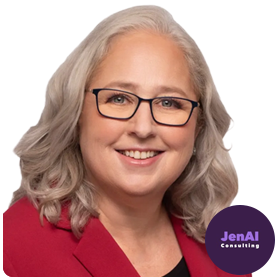
Jen Barnes-Nolan
Founder & Senior AI Advisor
JenAI Consulting
Jen Barnes-Nolan
About the Speaker:
Jen Barnes-Nolan is the founder of JenAI Consulting and an Open Group Distinguished Architect with 25+ years in enterprise technology and 10 years delivering AI in production. At IBM, she led technical delivery on Canada’s Old Age Security system replacement (80+ integration points across 33 systems) and AI programs for major Canadian banks and universities. As Head of Engineering at Architech, she founded the AI Focus Group that became the company’s AI delivery practice, co-authored its AI policy, and received its AI Innovation Award. She helps organizations move AI from pilot to production systems that hold up under real-world conditions.
Talk Title:
Track:
Sub Topic:
Abstract:
“If something can go wrong in production, it eventually will.”
Many teams are vibe-coding agents with tools powerful enough to build something impressive, and just enough to be dangerous. Sooner or later, those agents end up in production, or handed to another team to run.
Models can fail spectacularly, and teams spend most of their energy there: evals, guardrails, prompt tuning. But the boring stuff can bring your solution down just as hard. A downstream API times out, a dependency goes down, a queue backs up, or a tool returns half an answer. A traditional application throws an error. An agent may carry on and make something up, confidently, inside a real business process.
This talk applies decades of enterprise architecture lessons to agentic systems: timeouts, retries, fallbacks, idempotency, volume and failover, and the observability that tells you an agent improvised instead of failing. Drawn from large-scale integration and production AI delivery in banking, government and healthcare, it closes with a practical checklist teams can apply to their agents the following week.
What You’ll Learn:
Agents are being built faster than the teams around them are learning to run them. Many ML and AI practitioners have never had to operate distributed systems in production, so they focus on the model (evals, guardrails, prompts) while the end-to-end integration goes untested. This talk gives them the reliability patterns enterprise teams learned the hard way (timeouts, retries, fallbacks, idempotency, failover and observability), translated for agents. They leave with a checklist they can run against their own agents the following week, and a way to spot when an agent is quietly improvising instead of failing.

Erfan Pirmorad
Principal AI Scientist
Vanguard
Erfan Pirmorad
About the Speaker:
Erfan is a Principal AI Scientist at Vanguard’s AI Center of Excellence, where he leads work on AI safety & security, with a focus on adversarial testing, red teaming, and evaluation of LLM and agentic systems. His work spans the development of scalable evaluation frameworks, applied AI research, and translating emerging AI safety techniques into practical enterprise capabilities. He is particularly interested in building trustworthy AI systems that can operate safely and reliably in high-stakes, regulated environments.
Talk Title:
Track:
Sub Topic:
As AI systems evolve from single-turn models into agents that retrieve information, use tools, maintain memory, and execute multi-step tasks, traditional benchmark-based evaluation is no longer sufficient. This talk explores how the evaluation workflow must be redesigned around the full agent lifecycle: from threat modeling and adversarial scenario generation to trajectory-level evaluation, production observability, and regression testing.
Attendees will learn how to identify the expanding attack surface of agentic systems, design meaningful adversarial metrics beyond simple pass/fail benchmarks, and structure an evaluation architecture that connects pre-production testing with signals observed in production. The goal is to provide a practical framework for evaluating not just whether an agent performs well, but how it behaves when its environment, inputs, or intermediate state actively push it toward failure.
What You’ll Learn:
Learn how to redesign agent evaluation around the full lifecycle, threat modeling, adversarial scenario generation, trajectory-level evaluation, production observability, and regression testing, once static benchmarks stop capturing how production agents actually fail. Erfan covers how to identify the expanding attack surface of agentic systems, design adversarial metrics that go beyond simple pass/fail, and structure an evaluation architecture that connects pre-production testing with signals observed in production. Built inside a regulated enterprise, the focus is on evaluating not just whether an agent performs well, but how it behaves when its environment, inputs, or intermediate state actively push it toward failure.

Geoffrey Hunter
Staff Data Scientist
Curinos
Geoffrey Hunter
About the Speaker:
Technology leader with 12+ years of experience building and scaling high-performing Data Science and AI teams (10–15 people) that deliver revenue-generating data products. Proven track record leading LLM/agentic systems, dynamic pricing, recommender systems, and experimentation platforms that have driven $12M+ in new revenue, $2.5M in cost savings, and measurable acceleration of enterprise R&D. Excel at aligning data science strategy with executive priorities and building scalable data organizations at pace.
Talk Title:
Track:
Sub Topic:
Abstract:
As LLMs have gone mainstream, coding agents have emerged as both a powerful opportunity and a source of considerable debate. In this talk, I’ll share how I’ve integrated coding agents into my day-to-day workflow, the safeguards I use to maintain quality, and how they’ve changed the way I approach software development. Along the way, I’ll share practical lessons, unexpected challenges, and insights from hands-on experience.
My central thesis is simple: by investing in a capable coding agent and treating it much like a junior developer—providing clear direction, reviewing its work, and holding it to high standards—we can meaningfully improve our development velocity without sacrificing quality. I’ll explore how to make this approach work in practice and why learning to work effectively with coding agents is becoming an increasingly important skill for staying relevant in a rapidly evolving industry.
What You’ll Learn:
This talk gives technical practitioners a practical framework for using coding agents to accelerate their work without sacrificing quality. Drawing on real-world experience, it explores how to delegate effectively, establish safeguards, validate AI-generated code, and adapt existing workflows. Attendees will leave with actionable techniques for getting more value from coding agents, along with a clearer understanding of their limitations and how to use them responsibly across engineering and data disciplines.

Aditya Shukla
AI Engineer
Georgian
Aditya Shukla
About the Speaker:
Aditya Shukla is an AI Engineer in Georgian’s AI Lab, where he works with portfolio companies to accelerate their AI roadmap. Prior to Georgian, he worked at PayPal as a Machine Learning Engineer on the Merchant Pricing team, building agentic tools for enterprise document mining. Aditya attended the University of Toronto as a Master of Science in Applied Computing grad, and holds a Bachelor of Technology in Computer Science from SRM IST in Chennai. He has worked deeply across problems in agent evals and benchmarking, agentic software testing, as well as test-time scaling.
Talk Title:
Track:
Sub Topic:
Software is increasingly written by AI agents that autonomously produce an implementation from a user’s natural-language description (the specification), a practice known as agentic coding. Code is now produced faster than it can be reviewed, and code written this way has been shown to exhibit its own characteristic failure patterns. Property-based testing (PBT), a long-standing technique in which invariant properties of a program are checked against many generated inputs, has recently been revisited with LLM agents authoring the properties, thereby removing the high-effort derivation of invariants that has long hindered its adoption. Existing agentic PBT methods, however, derive these properties from the implementation alone (Code-driven PBT). Agentic coding presents an opportunity here: a thorough specification, whether a detailed prompt or a full product requirements document (PRD), has become central to the practice, yet its role in testing the resulting code remains underexplored. In this talk, we shed light on the value of the specification as a source of properties for testing agent-written code. Our key insight is that the specification, unlike the implementation, records what the code was meant to do, and invariants derived from it are not biased by how a particular implementation happens to do it. We propose Spec-Driven PBT, an agent that first expresses invariants in natural language from the specification and only then inspects the implementation to translate them into concrete tests. Across 25 application development tasks from the ViBench dataset, we compare Spec-Driven PBT with typical Code-driven PBT, and find that the bugs found solely by Spec-Driven PBT tend to violate documented product workflows, whereas those unique to Code-driven PBT instead concentrate on implementation robustness. We present this as evidence that the two approaches provide complementary value for bug discovery in agent-written code, and should be an active part of agent-driven programming.
What You’ll Learn:
How Georgian’s team turned the specification, a detailed prompt or PRD, into a source of tests for agent-written code. Aditya walks through Spec-Driven PBT, an agent that first expresses invariant properties in natural language from the spec and only then inspects the implementation to translate them into concrete tests — acting as a bug-hunting agent rather than a test-writer. Comparing it against code-driven property-based testing across 25 tasks from the ViBench dataset, he shows the two are complementary: spec-driven PBT surfaces violations of documented product workflows, while code-driven PBT concentrates on implementation robustness — backed by metrics, evaluations, and case studies of the bugs each method found.

Kevin Jiang
Consultant
RBC
Kevin Jiang
About the Speaker:
Kevin is a technology leader specializing in Data and AI. He leads teams at RBC building enterprise-scale platforms, AI-ready data and context capabilities that enable machine learning and agentic AI across hybrid-cloud environments.
Earlier in his career, Kevin founded tech startups, giving him firsthand experience building products and solving problems from an entrepreneurial perspective. He is also an inventor with multiple patent filings in data and AI, and has mentored
more than 50 university students.
Talk Title:
Track:
Sub Topic:
Abstract:
Your agents won’t get smarter by ingesting more data, they’ll just burn more tokens.
Enterprises rushing to deploy agentic AI are making a costly mistake: treating LLMs as a universal data processing layer. The result? Exploding token costs, unreliable reasoning, and agents that confidently act on data they don’t actually understand. Intelligent agents need more than access to data; they need data that comes with context, not just content. That means trusted quality signals, lineage that answers “where did this come from?”, semantic context that answers “what does this mean operationally?”, and discoverability that answers “is this even the right dataset?” This talk draws on real-world examples from complex enterprise operations to show how evolving your
data platform — through metadata, governance, and semantic layers — is the difference between agents that reason and act safely, and agents that hallucinate at scale.

Shivam Taneja
Consultant
RBC
Shivam Taneja
About the Speaker:
Shivam is a Senior Platform Engineer at RBC AI Ops, specializing in high-throughput data access and DevOps. Previously, he led cloud data-pipeline and WebReports initiatives for RBC Investor Services. Outside of work, He enjoys street photography and badminton.
Talk Title:
Track:
Sub Topic:
Your agents won’t get smarter by ingesting more data, they’ll just burn more tokens.
Enterprises rushing to deploy agentic AI are making a costly mistake: treating LLMs as a universal data processing layer. The result? Exploding token costs, unreliable reasoning, and agents that confidently act on data they don’t actually understand. Intelligent agents need more than access to data; they need data that comes with context, not just content. That means trusted quality signals, lineage that answers “where did this come from?”, semantic context that answers “what does this mean operationally?”, and discoverability that answers “is this even the right dataset?” This talk draws on real-world examples from complex enterprise operations to show how evolving your
data platform — through metadata, governance, and semantic layers — is the difference between agents that reason and act safely, and agents that hallucinate at scale.

Greg Wilson
Consultant
Third Bit
Greg Wilson
About the Speaker:
Dr. Greg Wilson is a programmer, author, and educator based in Toronto. He co-founded Software Carpentry, which has taught software skills to tens of thousands of researchers worldwide, and has authored or edited over a dozen books. Greg is a Fellow of the Python Software Foundation and a recipient of ACM SIGSOFT’s Influential Educator of the Year award.
Talk Title:
Track:
Sub Topic:
Abstract:
Most organizations don’t know how to assess the productivity of their software developers, which means that many claims about the impact of AI on productivity are vacuous. This talk analyzes some common mistakes, and describes a few things companies can do to figure out what is and isn’t actually cost-effective.
What You’ll Learn:
It will help them avoid the “simple but wrong” trap when it comes to assessing AI tooling and practices.

Mohammad Danesh
Head of Data and AI
Tangerine
Mohammad Danesh
About the Speaker:
Mohammad Danesh is the Head of Data and AI at Tangerine Bank, where he leads work focused on generative AI, intelligent agents, and the engineering foundations required to data and AI responsibly at scale. He is passionate about turning emerging capabilities into practical solutions that improve customer experiences, operations, and how software is built.
Talk Title:
Track:
Sub Topic:
The rapid adoption of Generative AI and agentic systems introduces operational challenges that extend beyond traditional application and machine-learning monitoring. Production AI systems must be continuously evaluated not only for availability and latency, but also for the quality, safety, and consistency of their outputs.
In this session, we will share how Tangerine built a continuous AI assurance platform that helps teams move from experimentation to production with confidence. We will discuss how to identify the right scoring mechanisms for different AI use cases, build and measure the effectiveness of golden datasets, extend test coverage using test-driven development (TDD) practices for agent tuning, establish pre-production red-teaming and quality gates, implement production monitoring, and create feedback loops that drive continuous improvement. Attendees will gain practical insights into building a repeatable framework for evaluating, governing, and monitoring AI systems throughout their lifecycle.
What You’ll Learn:
They will see what a leading digital bank is doing to bring in Evals and merge with TDD practices

Kevin Yan
Senior AI Engineer
Tangerine
Kevin Yan
About the Speaker:
Kevin Yan is a Senior AI Engineer at Tangerine, focusing on Agentic AI and AI/ML Platform. Previously, he led the AI engineering practices for enterprise agentic RAG solution at Chubb. His work spans across agent orchestration, evaluation frameworks, monitoring production AI systems, with a particular interest in making AI more measurable, reliable and scalable. He holds an Honours Bachelor of Mathematics degree from the University of Waterloo.
Talk Title:
Track:
Sub Topic:
Abstract:
The rapid adoption of Generative AI and agentic systems introduces operational challenges that extend beyond traditional application and machine-learning monitoring. Production AI systems must be continuously evaluated not only for availability and latency, but also for the quality, safety, and consistency of their outputs.
In this session, we will share how Tangerine built a continuous AI assurance platform that helps teams move from experimentation to production with confidence. We will discuss how to identify the right scoring mechanisms for different AI use cases, build and measure the effectiveness of golden datasets, extend test coverage using test-driven development (TDD) practices for agent tuning, establish pre-production red-teaming and quality gates, implement production monitoring, and create feedback loops that drive continuous improvement. Attendees will gain practical insights into building a repeatable framework for evaluating, governing, and monitoring AI systems throughout their lifecycle.
What You’ll Learn:
They will see what a leading digital bank is doing to bring in Evals and merge with TDD practices

Moamen Abdelrazek
Principal AI Engineer
Tangerine
Moamen Abdelrazek
About the Speaker:
Experienced AI and Machine Learning leader with a track record of building AI platforms and products at scale. Career highlights include edge AI deployments, architecting a transport platform for 2M+ visitors in Makkah, leading RAG and NLP platforms at RBC Borealis, and currently driving AI-powered personalization and orchestration at Tangerine. Focused on delivering measurable business impact through AI.
Talk Title:
Track:
Sub Topic:
The rapid adoption of Generative AI and agentic systems introduces operational challenges that extend beyond traditional application and machine-learning monitoring. Production AI systems must be continuously evaluated not only for availability and latency, but also for the quality, safety, and consistency of their outputs.
In this session, we will share how Tangerine built a continuous AI assurance platform that helps teams move from experimentation to production with confidence. We will discuss how to identify the right scoring mechanisms for different AI use cases, build and measure the effectiveness of golden datasets, extend test coverage using test-driven development (TDD) practices for agent tuning, establish pre-production red-teaming and quality gates, implement production monitoring, and create feedback loops that drive continuous improvement. Attendees will gain practical insights into building a repeatable framework for evaluating, governing, and monitoring AI systems throughout their lifecycle.
What You’ll Learn:
They will see what a leading digital bank is doing to bring in Evals and merge with TDD practices

Manav Shah
Founding ML Engineer
raindrop.ai
Manav Shah
About the Speaker:
Manav is an accomplished ML engineer and technical leader with deep experience in evaluations, reinforcement learning, information retrieval, and applied AI systems. At Raindrop AI, he works across machine learning, product, and software engineering, with a focus on monitoring and building AI agents for the real world. He previously led engineering at Dippy AI and Datapoint AI, where he scaled consumer AI systems to 10M+ users.
Talk Title:
Track:
Sub Topic:
Abstract:
To turn the art of building AI agents into a science, you need a way to measure progress — and measuring an agent turns out to be far harder, and far more important, than measuring a model. This talk is about how to actually evaluate agents: what to measure, how the field gets it wrong, and why good measurement is what eventually lets agents improve themselves.
What we’ll explore:
- What you’re really testing when you evaluate an agent — the model vs. the harness around it
- The building blocks of an eval: traces, datasets, and scoring — and the dimensions most people miss
- Where today’s benchmarks and LLM-as-judge break down, with real examples
- A practical playbook for measuring agent quality in development and in production
- How measuring success well opens the door to self-improving, self-healing agents
What You’ll Learn:
I have a unique vantage point on how some of the world’s leading AI companies are creating their AI agent lifecycles and developing their agent improvement flywheels.

Dr. Shaina Raza
Applied ML Scientist Responsible AI
Vector institute
Dr. Shaina Raza
About the Speaker:
Dr. Shaina Raza is an Applied Machine Learning Scientist, Responsible AI, at the Vector Institute, specializing in Responsible AI, multimodal and agentic AI evaluation, fairness, AI safety, and sustainable AI. She leads and contributes to research on trustworthy AI evaluation frameworks, deepfake detection, bias mitigation, and responsible deployment of advanced AI systems. Her work spans both academic research and industry-facing initiatives, including Horizon Europe projects and open-source Responsible AI tools. She has been recognized as a Responsible AI Leader of the Year 2025 and an Emerging Leader 2026, and was named among Elsevier’s Top 2% Scientists in 2025.
Talk Title:
Track:
Sub Topic:
As AI systems evolve from standalone models to increasingly autonomous agents, evaluation must evolve with them. Traditional benchmarks often focus on model-level accuracy, while real-world performance also depends on tools, memory, environments, context selection, orchestration, and the surrounding agent harness. This talk examines the shift toward system-level evaluation of LLMs and agentic AI, including robustness, safety, fairness, uncertainty, computational budgets, and reproducibility. It also considers multimodal agents operating on potentially manipulated evidence, where authenticity and provenance become part of evaluation. Drawing on our work in agentic evaluation and deepfakes, we outline practical principles for assessing AI systems in realistic settings and deployments.
What You’ll Learn:
Practitioners will learn how to evaluate AI systems beyond accuracy—covering fairness, safety, robustness, explainability, and sustainability—so they can identify risks earlier, choose more efficient evaluation strategies, and make better deployment decisions.

Abhimanyu Anand
Senior Data Scientist
Elastic
Abhimanyu Anand
About the Speaker:
Abhimanyu Anand is a Senior Data Scientist at Elastic, where Abhi works on the Agent Builder platform, across areas like context management, agent memory, and self improving agents. Throughout his career, Abhi’s work has spanned productionizing large-scale AI systems, such as agentic applications, chatbots, and recommender systems, for user bases exceeding hundreds of millions of people. Abhi has been involved in NLP for close to 10 years, through his Master’s, research, and industry experience, with his current focus on AI agents, continual learning, and large scale inference.
Talk Title:
Track:
Sub Topic:
Abstract:
Most teams building self improving agents follow a similar trajectory: the agent runs, reflects, updates an artifact, and the metric rises. In production, the metric can still rise while a later incident traces back to a learned change that passed review but was evaluated against the wrong signals.
This talk examines different self learning systems that may change the agent context, the agent harness, or model weights. Each offers different gains and failure modes. Memory can absorb sycophancy and inflate its reward signal. Skill libraries can overfit to the last task or be tainted by one bad run. Harness changes can discard useful behaviour as new tools arrive. Weight updates persist longest and are the hardest to reverse.
I’ll cover the controls that make self iteration viable in production: bounded, reversible updates; provenance for every learned artifact; promotion gates; and evaluations that separate improvement from noise.
What You’ll Learn:
Teams are starting to let agents learn from production use, but offline benchmarks and approval workflows do not show whether a learned change will hold up in live systems. This talk gives practitioners a way to decide what agents may change, what evidence is needed before promotion, and how to detect and reverse regressions when that evidence is incomplete.

Alex Tucker
Software Engineer
49ops
Alex Tucker
About the Speaker:
Alex Tucker is the founder of 49ops, a software consultancy specializing in Sovereignty, Django, AI Agents, and Spec-Driven Development. A web veteran building since the Geocities era, Alex was previously a senior engineering contributor at Shopify, Wave, and Mosaic Manufacturing. When not writing code, Alex is a lifelong FOSS advocate who can talk for hours about self-hosting cloud SaaS alternative
Talk Title:
Track:
Sub Topic:
Right now, teams wanting to deploy ML tools, agentic workflows or web apps on their own hardware usually face a wall of Kubernetes complexity. Lairkit solves this by providing automation to establish a sovereign, GitOps-lite deployment platform on any hardware (homelab, VPS, cloud instances) using existing tools rather than inventing a new API.
Because it uses established CLIs rather than new abstractions, it is incredibly Agent-friendly and even OSS models are already highly proficient at interacting with this stack in practice.
Behind the scenes, Lairkit uses Python Cookiecutter templates and interactive scripts to wire up securely:
- Forgejo & Action Runners for sovereign Git and CI (No more GitHub required)
- Infisical for secrets management
- Tailscale for SSH management and private networking
- Kamal for agentless, K8s-free multi-server deploys
What You’ll Learn:
The ultimate goal of the project (and the talk) is to lower the barrier for engineers to run their own sovereign software forge and deploy apps on their own infrastructure. For the presentation, I’d walk the audience through the architecture, demonstrate a deployment, and share why this K8s-free approach is a massive unlock for smaller AI teams.

Shashank Shekhar
Research Engineer
Google DeepMind
Shashank Shekhar
About the Speaker:
Shashank works as a Research Engineer on the Foundational Research Incubation team at Google DeepMind on post-training systems for foundation models and agents. Previously, he co-founded Dice Health, an AI automation platform for veterinary healthcare providers, and grew it from bootstrapping to acquistion. His research at Meta AI received the NeurIPS 2022 best paper award, at the most prestigious AI research conference. Outside of work, he also runs the Toronto Machine Learning systems group which covers topics like training, inference and deployment of AI systems from consumer devices to large datacenters. He has served as a technical advisor to the Vector Institute and various seed and Series A stage startups.
Talk Title:
Track:
Sub Topic:
Abstract:
What You’ll Learn:
Practitioners can start to think about how they can use self-improving AI agents for tasks relevant to them

Anton Shesternev, PhD
Lead Applied AI Research Scientist
CIBC
Anton Shesternev, PhD
About the Speaker:
Anton Shesternev is a Lead Applied AI Research Scientist at CIBC, where he leads an AI benchmarking and evaluation research pod focused on advancing enterprise AI capabilities. His work spans Large Language Models, AI evaluation, and multimodal document understanding, with an emphasis on developing reliable AI systems and rigorous evaluation methods for complex, real-world financial workflows. He holds a PhD in Economics and an MBA from the Schulich School of Business at York University.
Talk Title:
Track:
Sub Topic:
Most AI benchmarks are optimized for public datasets and generic tasks, but enterprise teams operate in a very different reality: domain-specific workflows, regulated data, multimodal inputs, and business-critical quality thresholds. This talk presents the CIBC Benchmark, an enterprise evaluation framework designed to test AI models and workflows against real enterprise tasks, enterprise-relevant datasets, and standardized evaluation metrics.
What You’ll Learn:
- A simple but scalable way to structure enterprise AI benchmarking
- A framework that works across models, prompts, tools, and end-to-end workflows
- A better method for connecting benchmark design to real business use cases
- A way to make evaluation results more useful for deployment and governance decisions
- A more mature view of performance that includes not only correctness, but also speed, cost, and consistency

Christopher Trudeau
Fractional CTO
arSensa Inc.
Christopher Trudeau
About the Speaker:
Christopher Trudeau is a fractional CTO who works with teams to improve both their technical capabilities and their software delivery processes. He has built high performing teams in a variety of industries, including gaming, marketing, travel, finance, government, and consulting. He is also the co-host of The Real Python Podcast, the creator of over 100 training courses, and author of Django in Action.
Talk Title:
Track:
Sub Topic:
Abstract:
Just what does it mean to be a developer? The answer varies widely. One aspect ranges from coding for yourself to being part of a team, while another aspect is one-off tools vs highly available production systems with millions of users. The tools of the trade have changed over the years but the central ideas have remained constant.
Devinder Kumar
Head - ML Systems & Engineering
TD Bank
Devinder Kumar
About the Speaker:
ML engineering leader bridging cutting-edge research and enterprise-scale production. Currently leading ML Systems & Engineerg group at TD Bank (AI Platform).
I am passionate about building high-performance teams & delivering AI solutions that make a difference. Academic foundation includes a PhD in Machine Learning from UWaterloo and a Postdoctoral Fellowship at Stanford.
Talk Title:
Track:
Sub Topic:
Abstract:
Diederik van Liere
Chief Technology Officer
Wealthsimple
Diederik van Liere
About the Speaker:
Diederik van Liere is the Chief Technology Officer at Wealthsimple,Canada’s leading financial innovator serving more than 4 million Canadians and holding approximately $155 billion in assets under administration as of June 30, 2026.. He is a technology leader who has built impactful data science and engineering teams for global brands at scale. He joined Wealthsimple in 2018 as Head of Data Science and Engineering and assumed the role of Chief Technology officer in March 2023. Prior to joining Wealthsimple, Diederik built complex data pipelines and infrastructure as the Director of Data Science at Shopify. He also helped build the data platform at the Wikimedia Foundation (the custodian of Wikipedia and sister projects).
Diederik holds a PhD from the Rotterdam School of Management in the Netherlands, in the area of complex networks and was a Postdoctoral Researcher at Toronto’s Rotman School of Management.
Talk Title:
Track:
Sub Topic:
Abstract:
Layla El Asri
Director, Machine Learning Research Borealis AI
RBC
Layla El Asri
About the Speaker:
Layla leads RBC Borealis’ research in Responsible AI as well as projects exploring how to apply Generative AI in the financial domain. She is also a sessional lecturer for the Rotman Master of Management Analytics (MMA) where she teaches about Generative AI. She completed a Ph.D. in computer science at Université de Lorraine in France in 2016. She worked as a research scientist and research manager at Maluuba and Microsoft Research prior to joining RBC. Layla has several publications in top-tier conferences on the topics of reinforcement learning, natural language processing, and representation learning. She also has a track record of building and delivering robust AI solutions to RBC businesses including wealth management, home equity finances, capital markets, and commercial credit.
Talk Title:
Track:
Sub Topic:
Abstract:
As AI agents become more autonomous and handle increasingly complex tasks, evaluating their performance has become a critical challenge. This task is particularly difficult because natural language is inherently subjective, context-dependent, and resists simple quantification. This talk will present practical frameworks for assessing agent performance, starting with LLM-as-judge approaches that enable rapid prototyping and scaled evaluation of these nuanced, subjective qualities. We’ll explore when these judges are invaluable versus when they fail, uncovering hidden biases like position preference, verbosity bias, and inconsistent scoring that can mislead your evaluation pipeline. The session then progresses to introducing calibrated scorers and how such such automated systems can be leveraged to evaluate various parts of complex agents.
Sana Tonekaboni
Senior Machine Learning Research Borealis AI
RBC
Sana Tonekaboni
About the Speaker:
Sana is a Senior Machine Learning Researcher at RBC Borealis and a Research affiliate at MIT. Her research focus is on Responsible AI, ensuring AI models are deployed safely and responsibly in different applications. She received her PhD in computer science from the University of Toronto, and prior to joining Borealis, she was a Postdoctoral fellow at the Broad institute of MIT and Harvard.
Talk Title:
Track:
Sub Topic:
Abstract:
As AI agents become more autonomous and handle increasingly complex tasks, evaluating their performance has become a critical challenge. This task is particularly difficult because natural language is inherently subjective, context-dependent, and resists simple quantification. This talk will present practical frameworks for assessing agent performance, starting with LLM-as-judge approaches that enable rapid prototyping and scaled evaluation of these nuanced, subjective qualities. We’ll explore when these judges are invaluable versus when they fail, uncovering hidden biases like position preference, verbosity bias, and inconsistent scoring that can mislead your evaluation pipeline. The session then progresses to introducing calibrated scorers and how such such automated systems can be leveraged to evaluate various parts of complex agents.
Xuye Liu
Machine Learning Research Borealis AI
RBC
Xuye Liu
About the Speaker:
Xuye is a Machine Learning Researcher at RBC Borealis in Toronto. His work spans Responsible AI and multimodal learning, focusing on making vision-language and retrieval-augmented generation systems more transparent and verifiably grounded in their sources. He completed a Ph.D. in Computer Science at the University of Waterloo. Xuye has published at top-tier conferences on multimodal learning, and natural language processing, including ACL, NAACL, EMNLP, NeurIPS, and CHI.
Talk Title:
Track:
Sub Topic:
Abstract:
As AI agents become more autonomous and handle increasingly complex tasks, evaluating their performance has become a critical challenge. This task is particularly difficult because natural language is inherently subjective, context-dependent, and resists simple quantification. This talk will present practical frameworks for assessing agent performance, starting with LLM-as-judge approaches that enable rapid prototyping and scaled evaluation of these nuanced, subjective qualities. We’ll explore when these judges are invaluable versus when they fail, uncovering hidden biases like position preference, verbosity bias, and inconsistent scoring that can mislead your evaluation pipeline. The session then progresses to introducing calibrated scorers and how such such automated systems can be leveraged to evaluate various parts of complex agents.
Burak Yildiz, Ph.D.
Senior ML Engineer
Wisedocs
Burak Yildiz, Ph.D.
About the Speaker:
Burak led the performance and cost optimization of Wisedocs’ document pipeline, as well as developing their Legal Analysis and Insights platform. Prior to that, he managed the engineering team at Skinopathy, where he created a dermatology focused, AI-first EHR system. He has a PhD from the University of Waterloo on Applied Operations Research, where he contributed to the literature on various logistics and warehouse optimization problems.
Talk Title:
Track:
Sub Topic:
Abstract:
Model, Data and Objective Drift have traditionally ML Engineering problems that have had a ceiling where we could automate. This talk is a case study of how Wisedocs automated large portions of model development across a 1500+ document types that face standard MLOps challenges. The talk will have three parts, a focus on domain knowledge, the ROI of agentic ML development and sample harnesses and skills we use to enable these capabilities.
What You’ll Learn:
Agentic ML is an evolving form of automating ML workflows while maintaining strong data validation, efficiency and cost consideration
Aryan Dhar
Senior ML Engineer
Wisedocs
Aryan Dhar
About the Speaker:
Aryan Dhar is a Senior Machine Learning Engineer at Wisedocs and a Pearson Scholar alumnus of the University of Toronto. At Wisedocs, he led the development of the ML platform powering the Wisedocs Intelligence Engine, alongside work on fine-tuning and deploying specialized models. His broader work focuses on building, evaluating, and benchmarking of non-deterministic LLM systems. He was part of the team that developed MLCR, a benchmark designed to assess the Medical Long Context Reasoning capabilities of frontier models. Previously, Aryan worked at Equinix and Cerebras Systems.
Talk Title:
Track:
Sub Topic:
Abstract:
Model, Data and Objective Drift have traditionally ML Engineering problems that have had a ceiling where we could automate. This talk is a case study of how Wisedocs automated large portions of model development across a 1500+ document types that face standard MLOps challenges. The talk will have three parts, a focus on domain knowledge, the ROI of agentic ML development and sample harnesses and skills we use to enable these capabilities.
What You’ll Learn:
Agentic ML is an evolving form of automating ML workflows while maintaining strong data validation, efficiency and cost consideration
Mario Hernández
Senior ML Engineer
Wisedocs
Mario Hernández
About the Speaker:
Talk Title:
Track:
Sub Topic:
Abstract:
Managing 10,000+ prompts across dozens of use cases is a challenging task when new LLMs get released weekly. This talk covers the infrastructure, automation and LLM based prompt that allows Wisedocs to automatically update prompts with new product releases, classify error categories and empower prompt engineers to focus on emerging, challenging problems, rather than maintanance.
What You’ll Learn:
Prompts are a key
Afseen Syeda
Lead Prompt Engineer
Wisedocs
Afseen Syeda
About the Speaker:
Afseen Syeda is a Lead Prompt Engineer at Wisedocs, where she works alongside the machine learning team to design and refine prompts that make AI more effective at processing and reasoning over complex medical documents. Her focus is getting the most out of AI models through thoughtful prompting, from extraction accuracy to workflow efficiency.
Talk Title:
Track:
Sub Topic:
Abstract:
Managing 10,000+ prompts across dozens of use cases is a challenging task when new LLMs get released weekly. This talk covers the infrastructure, automation and LLM based prompt that allows Wisedocs to automatically update prompts with new product releases, classify error categories and empower prompt engineers to focus on emerging, challenging problems, rather than maintanance.
What You’ll Learn:
Prompts are a key
Nadia Rauch
AVP, AI Engineering | Principal AI Engineer
Chubb
Nadia Rauch
About the Speaker:
Nadia is an AVP of AI Engineering at Chubb, where she leads teams building AI and machine learning solutions at scale. With 14+ years of experience building products and working with data across multiple roles — including leading Nalys’ Machine Learning and Data Engineering teams — she brings a wealth of expertise to her current position. Nadia holds a Bachelor’s and Master’s degree in Computer Engineering from the University of Florence and specialises in Knowledge Bases and Ontologies. During her doctoral studies, she developed a pioneering Smart City system, an innovative project which showcased her ability to harness data from diverse sources to create actionable insights for urban planning and management.
Additionally, Nadia is a dedicated advocate for diversity in tech, serving as a committee member for TMLS – Women x AI, where she empowers young women entering the field.
Talk Title:
Track:
Sub Topic:
Abstract:
We built a multi-agent pipeline to automate a complex, document-intensive enterprise workflow. The initial system ran sequentially through a chain of specialized agent roles, each handling a distinct task in the process, using a single frontier model throughout. It worked. It was also slow and expensive, and we didn’t know why.
Rather than optimize blindly, we profiled first. The results were not where we expected: 67% of total latency came from a small minority of the agent roles, and the primary bottleneck was not the model — it was sequential chaining: independent work was being processed one step at a time instead of concurrently. Identifying and parallelizing the roles with no inter-dependency reduced end-to-end runtime by roughly 40%.
The second experiment compared model tiers (frontier, mid-tier, lightweight) across each agent role independently, measuring accuracy, latency, and cost per role. The finding cuts against the default assumption: the roles that appeared most cognitively demanding required frontier models, but the accuracy gap was smaller than expected. The roles where model downgrade failed were the ones responsible for precise structured extraction — tasks where errors propagate silently downstream and surface only at the output. Swapping to mid-tier models on roles that tolerated it reduced per-run cost by ~40%, with an estimated <2% accuracy impact at the role level and <1% at the pipeline output level.
The third experiment compared orchestration harnesses — evaluating how the choice of agentic framework affects runtime overhead, observability, and the ease of implementing the parallelization and model-swap changes described above. Framework choice turned out to matter more than expected for operational concerns: debugging multi-agent failures, tracing costs per agent, and modifying execution flow without rewriting pipeline logic.
Operating in a regulated enterprise environment added one constraint worth naming: every agent decision needs to be auditable. This ruled out certain optimization shortcuts that would have been acceptable in other contexts and shaped how we defined “accurate enough” per role.
This talk covers the profiling methodology, the per-role model comparison framework, the parallelization decisions, the harness comparison, and the operational lessons — including what we’d instrument from day one if we rebuilt the system today.
Cost and accuracy figures for the parallelization and model-tier experiments are preliminary; the formal evaluation is in progress and will be updated with measured results before the talk.
What You’ll Learn:
Our team built a working multi-agent pipeline in 3 weeks. It worked. It also ran in 75+ minutes per case and cost over $100 per run. Before optimizing, we needed to answer two questions most teams skip: where does the time and money actually go in a multi-agent system, and does every agent role actually need a frontier model?
Adam Hendin
Co-Founder & CEO
Radium
Adam Hendin
About the Speaker:
Adam Hendin is co-founder and CEO of Radium, a Canadian enterprise AI company providing models, APIs and infrastructure. A serial entrepreneur with more than 18 years of experience, Adam has built and exited technology ventures across North America and Europe. His work has spanned software, digital infrastructure, advanced manufacturing and international supply chains, giving him a practical perspective on what it takes to build and scale technology companies across borders. He has expanded sales and distribution networks into more than 26 countries and negotiated agreements with companies including Best Buy, Rogers, AT&T and TELUS. His previous roles include President of HendinTech, co-founder of Inspired Photonics, CEO of Motion Networks and founder of Smart One Media.
Talk Title:
Track:
Sub Topic:
Abstract:
No country can own every layer of the AI stack. Models, chips, infrastructure, capital, talent and customers already cross borders, making technological purity an unrealistic measure of sovereignty. Drawing on Radium’s experience as a Canadian-headquartered but globally constituted AI company (an “mutt AI company”) this talk proposes a more practical objective: strategic independence, defined as the ability to choose, adapt, operate and replace critical technologies while retaining domestic expertise, infrastructure and economic value.
Rather than asking whether every component was invented in Canada, the talk asks which capabilities Canada must originate, which it can source internationally, and what it must be able to control, operate and govern at home. It also confronts a central Canadian contradiction: while Canada talks about building sovereign AI, its capital, procurement and scaling environment often pushes its most ambitious entrepreneurs to build their companies in the United States.
What You’ll Learn:
Takeaways for technology leaders and policymakers
- Map the AI stack and decide which layers must be owned vs controlled, vs sourced externally.
- Concentrate engineering resources on where the organization can create differentiated customer value
- Assess dependencies by whether critical technologies can be adapted, operated, governed and replaced vs where they originated.
- Avoid dependence on a single model, hardware provider or deployment environment.
- Measure sovereign capability by what remains domestically, e.g., companies, expertise, infrastructure, customer relationships and economic value, vs technological purity.
Navya Mehta
Principal Engineer and Tech Lead - Compiler Engineering
EnCharge AI
Navya Mehta
About the Speaker:
Navya is a compiler engineer building analog in-memory compute chips to bring energy efficiency to the data center and the edge. He TLs the compiler effort at EnCharge, a DARPA-backed Series B chip company, and spreads his time across low-level scheduling algorithms for dataflow, performance frontiers for different classes of workloads, and hw-sw codesign both at the chip and the system level to power inference.
Talk Title:
Track:
Sub Topic:
Abstract:
How do we think about optimizing the hardware for inference when it comes to agentic workloads? what is the tradeoff between interactivity and throughput and how does that affect hardware design decisions? I aim to build up an example from optimizing kernels (aka compute), up to optimizing memory management, to optimizing the topology at the data center level, to designing specific hardware itself for different tradeoffs across the interactivity-throughput paretto frontier.
What You’ll Learn:
How to think about designing heterogenous compute infrastructure for different types of workloads
Yahya Mowiena
Senior Director of Engineering
RBC
Yahya Mowiena
About the Speaker:
Yahya builds AI for everyone, not just engineers. His agentic assistant at RBC Borealis serves 70,000 employees across Royal Bank of Canada, built to bank-grade standards.
Talk Title:
Track:
Sub Topic:
Abstract:
New models, frameworks and agent harnesses arrive every few weeks, and teams that build on them end up re-architecting every quarter. This talk makes the case for betting on what lasts instead: a small set of durable primitives such as identity, model and tool gateways, policy, a governed runtime, memory, evaluation and audit. Drawing on our experience building an enterprise AI platform inside a regulated bank, I’ll show how to tell a primitive from a trend, why the harness should be a replaceable tenant rather than a foundation, and how to adopt community advances at their pace without compromising on security or compliance.
What You’ll Learn:
Build a scalable agentic platform that serves users at scale
Alex Tucker
Software Engineer
49ops
Alex Tucker
About the Speaker:
Alex Tucker is the founder of 49ops, a software consultancy specializing in Sovereignty, Django, AI Agents, and Spec-Driven Development. A web veteran building since the Geocities era, Alex was previously a senior engineering contributor at Shopify, Wave, and Mosaic Manufacturing. When not writing code, Alex is a lifelong FOSS advocate who can talk for hours about self-hosting cloud SaaS alternative
Talk Title:
Track:
Sub Topic:
Abstract:
Right now, teams wanting to deploy ML tools, agentic workflows or web apps on their own hardware usually face a wall of Kubernetes complexity. Lairkit solves this by providing automation to establish a sovereign, GitOps-lite deployment platform on any hardware (homelab, VPS, cloud instances) using existing tools rather than inventing a new API.
Because it uses established CLIs rather than new abstractions, it is incredibly Agent-friendly and even OSS models are already highly proficient at interacting with this stack in practice.
Behind the scenes, Lairkit uses Python Cookiecutter templates and interactive scripts to wire up securely:
- Forgejo & Action Runners for sovereign Git and CI (No more GitHub required)
- Infisical for secrets management
- Tailscale for SSH management and private networking
- Kamal for agentless, K8s-free multi-server deploys
What You’ll Learn:
The ultimate goal of the project (and the talk) is to lower the barrier for engineers to run their own sovereign software forge and deploy apps on their own infrastructure. For the presentation, I’d walk the audience through the architecture, demonstrate a deployment, and share why this K8s-free approach is a massive unlock for smaller AI teams.
Kathryn Hume
VP AI Engineering
Vector Institute
Kathryn Hume
About the Speaker:
Kathryn Hume leads AI Engineering at the Vector Institute, where she builds tools and platforms that further industry adoption of frontier AI. Prior to joining Vector, she held multiple technology leadership roles in financial services and AI, including Chief Technology Officer for Tangerine Bank, Vice President of Technology for RBC’s mobile, online banking, and direct investing businesses, and Interim Head of Borealis AI, RBC’s AI research institute. Before joining RBC, she held leadership roles at AI startups integrate.ai and Fast Forward Labs (acquired by Cloudera).
Kathryn is a recognized author and public speaker, with work appearing at TED, the Harvard Business Review, and the Globe & Mail. She has served as a guest lecturer and adjunct professor — teaching courses on applied AI and responsible AI — at the Harvard Business School, Stanford, the University of Toronto, and the University of Calgary. She is a mother of two young boys, a board member at CanadaHelps active in the charity sector, and an advocate for women in technology and educational reform in the age of generative AI.
Talk Title:
Track:
Sub Topic:
Wendy Foster
Principal Data Scientist
Disco
Wendy Foster
About the Speaker:
Wendy is a principal data scientist at Disco, a Toronto based educational technology startup. She has over a decade of experience building data products and teams at scale. Previously, she has held data leadership positions at Shopify, PagerDuty, and Wattpad.
Talk Title:
Track:
Sub Topic:
Disco’s MCP server lets learning operators and administrators manage and generate insight about their programs through AI agents instead of dashboards, which means those agents need to be trustworthy, not just capable. This talk walks through how we built our eval process for MCP tools, from defining what ‘correct’ looks like for operator-facing actions to structuring a dataset that catches failures before operators do.
What You’ll Learn:
Most organizations building on MCP are still treating it like a plumbing problem (get the tools connected, ship it) without a rigorous way to know whether the agent is actually doing the right thing when it touches real operator data and workflows. This talk gives practitioners a concrete, repeatable process for building evals that catch agent failures before they reach production, using a real multi-phase MCP rollout as the case study.
Erin Li
Head of AI Research
CIBC
Erin Li
About the Speaker:
Head of AI Research at CIBC, with twelve years at the financial sector spanning every stage of the path research must travel to become value. Erin set her research priorities with business accountability, production relevancy, and clear governance, so frontier work is scoped from the outset against what institutions can operationalize, govern and monetize.
Talk Title:
Track:
Sub Topic:
Most AI benchmarks are optimized for public datasets and generic tasks, but enterprise teams operate in a very different reality: domain-specific workflows, regulated data, multimodal inputs, and business-critical quality thresholds. This talk presents the CIBC Benchmark, an enterprise evaluation framework designed to test AI models and workflows against real enterprise tasks, enterprise-relevant datasets, and standardized evaluation metrics.
What You’ll Learn:
- A simple but scalable way to structure enterprise AI benchmarking
- A framework that works across models, prompts, tools, and end-to-end workflows
- A better method for connecting benchmark design to real business use cases
- A way to make evaluation results more useful for deployment and governance decisions
- A more mature view of performance that includes not only correctness, but also speed, cost, and consistency
Akash Shetty
CTO
Publicus
Akash Shetty
About the Speaker:
Akash Shetty is the co-founder and CTO of Publicus, a Canadian GovTech company building AI-native infrastructure for government procurement.
At Publicus, Akash leads the development of production systems that transform fragmented contracts, tenders, invoices, amendments, task authorizations, webpages, and PDFs into structured, traceable intelligence for businesses and public-sector organizations. His work spans multimodal document processing, retrieval and ranking, agent orchestration, evaluation, data lineage, human review, and the deployment of trustworthy AI workflows in environments involving public money and institutional accountability.
Publicus has completed federal work supporting Buy Canada decision-making and is working on procurement modernization through Innovative Solutions Canada and Public Services and Procurement Canada. Akash approaches AI as a builder shaped by physics and first-principles thinking, with a focus on moving beyond impressive prototypes toward systems that can be verified, operated, and trusted in the real world.
Talk Title:
Track:
Sub Topic:
Publicus processes procurement data spread across RFPs, contracts, amendments, award notices, invoices, task authorizations, webpages, and other records. Our early AI workflows optimized for producing a useful answer: retrieve relevant context, reason over it, generate structured output, and evaluate the result. That worked until we tried to increase automation in workflows where an answer can be semantically correct while its evidence is incomplete, stale, contradictory, or simply the wrong source.
We redesigned the system around an evidence ledger rather than the generated answer. Extracted facts and agent claims became typed artifacts carrying source document, location, provenance, transformation history, confidence, and conflicts. Retrieval became evidence acquisition rather than context stuffing. Verification became a separate stage that reconciles claims across records. Unsupported or conflicting outputs cross an explicit human-review boundary instead of being silently converted into fluent prose.
The redesign also changed how we evaluate the system. Instead of relying primarily on answer quality or a single LLM-as-judge score, we measure the pipeline at several boundaries: field-extraction F1, claim-to-source agreement, evidence-grounding accuracy, conflict detection precision/recall, unsupported-output rate, lineage coverage, bilingual performance, latency, cost per document, and human-review burden.
I’ll walk through the production architecture, the failure modes that forced the redesign, where deterministic code replaced model judgment, how we preserve evidence through multi-step agent execution, and how we decide whether a new model or workflow is actually safe to promote.
Attendees will leave with a practical pattern for building agents where correctness means more than producing the right-looking answer: designing typed evidence artifacts, separating retrieval from verification, constructing evals around failure boundaries, and defining human escalation rules for high-stakes AI systems.
Sayantan Das
Member of Technical Staff
MyChoice
Sayantan Das
About the Speaker:
I’m a Senior Applied AI Scientist at Manulife, where I work as an internal Forward Deployed Engineer — sitting close to the business and closer to the metal — building agentic AI products tied to real business outcomes.
Previously, I owned RLOps from thought to production at Prem Labs for their agent finetuning platform, now live on AWS Marketplace. I’m an early contributor to Hugging Face’s trl library, the most widely used LLM finetuning library in the world.
I completed my Master in Applied Science from Queen’s University under the supervision of Dr. Ali Etemad. My research on Deepfake Detection was partially funded by the Vector Institute Scholarship in AI. Published in NeurIPS and TMLR. Reviewer at NeurIPS and ICASSP 2026. Listen to this podcast to know more.
In the 5pm–9am part of my life, I advise and help traditional businesses become AI-ready.
Talk Title:
Track:
Sub Topic:
This session reframes “Loop Engineering” as applied cybernetics — the same observe→diff→act reconciliation pattern that powers Kubernetes controllers, now applied to AI agent loops. Attendees will learn how to map K8s design principles (declarative goals, idempotent actions, crash-only design, admission webhooks as HITL gates) directly onto agent infrastructure, and walk away with a concrete checklist for building production agent loops that self-heal, externalize state, and fail gracefully. We’ll cover real failure modes — thrashing, stale reads, infinite reconciliation, conflicting controllers — and the fixes that transfer from a decade of K8s production learnings.
What You’ll Learn:
- Define exit conditions, not paths. “All tests pass” is a reconciliation target; a 47-step plan is fragile.
- Make every action idempotent. If the loop re-executes a step, nothing should break or duplicate.
- Externalize state aggressively. The agent should be killable and another instance should pick up seamlessly.
- Observe before every action. Never trust cached context — always re-read current reality.
- Add backoff and damping. Loops that over-correct on each iteration thrash (same as K8s pod autoscaler oscillation).
- Set hard ceilings. Max iterations, cost budget, and human gates prevent infinite reconciliation on unreachable goals.
- Scope ownership clearly. Two loops editing the same file without coordination will conflict — use labels/task-scoping just like K8s selectors.
Saeid Abolfazli
Global Head of Data Platform and AI
Rakuten Kobo
Saeid Abolfazli
About the Speaker:
Saeid Abolfazli is the global head of Data, Platform and AI at Rakuten Kobo, where he supports the end to end lifecycle of data to enable data-driven decision making at scale. He is also an adjunct faculty member at the University of Toronto, where he teaches applied machine learning and AI. With a PhD in Computer Science and extensive experience in industry and academia, Saeid bridges research and practical AI implementation, with a focus on building solutions that deliver measurable impact.
Talk Title:
Track:
Sub Topic:
When your BI team has 1000+ workbooks and a growing request backlog, the answer isn’t more analysts — it’s rethinking the architecture. In this talk we share how Rakuten Kobo’s Data team replaced a centralized BI bottleneck with a code-first model where dashboards are version-controlled files authored end-to-end by AI. We cover the [long-term] strategy, tooling decision, the AI-guided authoring workflow built on Claude Code and Cloud, the real operating boundaries discovered through production-scale data. Attendees will leave with a concrete architecture pattern, an honest account of where the approach has limits, and a staged AI coding model they can adapt to any BI environment.
What You’ll Learn:
We are on the forefront of this shift from BI tools to open source (with the option to still buy commercial license) and this success story can empower and encourage others to follow the suit and start transforming their organizations. This is very practical presentation where companies can mimmic in a few weeks.
Daniel Coe
Senior Manager of Data
Rakuten Kobo
Daniel Coe
About the Speaker:
Daniel Coe is the Senior Manager of Data Intelligence at Rakuten Kobo, where he leads multi-disciplinary teams spanning business intelligence and data platform engineering to enable scalable, data-driven operations. With extensive leadership experience across the e-commerce and retail sectors, he specializes in cloud-native data modernization, scalable warehouse architecture, and semantic layer design. Bridging deep technical execution with strategic agile leadership, Daniel focuses on building high-performing technical teams and transforming complex data infrastructure into high-value business outcomes.
Talk Title:
Track:
Sub Topic:
When your BI team has 1000+ workbooks and a growing request backlog, the answer isn’t more analysts — it’s rethinking the architecture. In this talk we share how Rakuten Kobo’s Data team replaced a centralized BI bottleneck with a code-first model where dashboards are version-controlled files authored end-to-end by AI. We cover the [long-term] strategy, tooling decision, the AI-guided authoring workflow built on Claude Code and Cloud, the real operating boundaries discovered through production-scale data. Attendees will leave with a concrete architecture pattern, an honest account of where the approach has limits, and a staged AI coding model they can adapt to any BI environment.
What You’ll Learn:
We are on the forefront of this shift from BI tools to open source (with the option to still buy commercial license) and this success story can empower and encourage others to follow the suit and start transforming their organizations. This is very practical presentation where companies can mimmic in a few weeks.
Steve Choi
Manager of Data Analytics
Rakuten Kobo
Steve Choi
About the Speaker:
Steve Choi is the Manager of Data Analytics at Rakuten Kobo. He leads a team of analytics engineers who enable the wider organization to understand and act on their data. He has over a decade of experience spanning analytics, data science and data engineering. His current focus is on applying AI agents towards data analysis and rethinking how a data team works with its stakeholders.
Talk Title:
Track:
Sub Topic:
When your BI team has 1000+ workbooks and a growing request backlog, the answer isn’t more analysts — it’s rethinking the architecture. In this talk we share how Rakuten Kobo’s Data team replaced a centralized BI bottleneck with a code-first model where dashboards are version-controlled files authored end-to-end by AI. We cover the [long-term] strategy, tooling decision, the AI-guided authoring workflow built on Claude Code and Cloud, the real operating boundaries discovered through production-scale data. Attendees will leave with a concrete architecture pattern, an honest account of where the approach has limits, and a staged AI coding model they can adapt to any BI environment.
What You’ll Learn:
We are on the forefront of this shift from BI tools to open source (with the option to still buy commercial license) and this success story can empower and encourage others to follow the suit and start transforming their organizations. This is very practical presentation where companies can mimmic in a few weeks.
Prashanth Rao
Co-Founder, AI Engineer & Researcher
Hyperdimensional Computing Labs
Prashanth Rao
About the Speaker:
Prashanth works at the intersection of data infrastructure, graphs, and agentic systems. He’s constantly thinking about how graph and vector representations can be combined so that agents retrieve better context than either is able to provide on its own.
Prashanth regularly builds benchmarks and end-to-end case studies that put the tradeoffs between tools and techniques across different paradigms on the record, enabling architectural decisions to be based on tangible evidence rather than claims.
Talk Title:
Track:
Sub Topic:
What if AI systems could learn continuously without repeatedly retraining the model underneath them? At HDC Labs, we are exploring hyperdimensional computing as a representation layer for online, associative learning. Neural models provide powerful learned representations and general capabilities; hyperdimensional representations provide a lightweight structure in which new observations, relationships, corrections, and outcomes can be incorporated as they arrive. Because learning can happen through simple composable operations over these representations, useful behavior can emerge from relatively few examples rather than large retraining datasets.
That same compositional structure also creates an opportunity for greater explainability. Instead of treating every update as an opaque change to model weights, hyperdimensional representations can preserve the primitives and associations that contributed to a result, making retrieval and reasoning easier to inspect. In this talk, we will show how HDC can complement modern ML systems with three capabilities that matter increasingly in the agentic age: explainable representations, continuous online learning, and sample-efficient adaptation.
What You’ll Learn:
Practitioners increasingly need AI systems that can incorporate new information after deployment without continuously retraining or fine-tuning large models. Hyperdimensional computing offers a lightweight representation layer where new examples and associations can be learned online, often from very little data, while keeping the underlying operations composable and inspectable. This can make deployed systems cheaper to update, faster to adapt, and easier to understand, .especially in agentic, edge, and rapidly changing environments.
Suhas Pai
CTO & Co-Founder
Hudson Labs
Suhas Pai
About the Speaker:
Suhas Pai is a NLP researcher and co-founder/CTO at Hudson Labs, a Toronto based Y-combinator backed startup. He is the author of the book ‘Designing Large Language Model Applications’, published by O’Reilly Media. He has led/contributed to the development of several open-source LLMs, including BLOOM, Aurora-M etc. Suhas is active in the ML community, being Chair of the TMLS (Toronto Machine Learning Summit) conference since 2021. He is also a frequent speaker at AI conferences worldwide, and hosts regular seminars discussing the latest research in the field of NLP.
Talk Title:
Track:
Sub Topic:
Enterprise AI work has shifted from “generate text” to “make a decision”: routing, scoring, classification, triage. New models built to skip autoregression entirely (a category sometimes called “System 1” AI) promise order-of-magnitude speed and cost gains for exactly these tasks, without giving up transformer-grade reasoning. For teams running AI in real-time or high-volume pipelines, this is a shift worth understanding.
What You’ll Learn:
Learn where “Decision Models” fit in the agentic stack — a class of models built to skip autoregression entirely (sometimes called “System 1” AI) for the decisions enterprise AI increasingly runs on: routing, scoring, classification, and triage. Suhas and Lily cover how these models deliver order-of-magnitude speed and cost gains on those tasks without giving up transformer-grade reasoning, and why that matters for teams running AI in real-time or high-volume pipelines. Expect the case for why Decision Models are reshaping how agents are developed and deployed — including why this isn’t simply “classification tasks rediscovered.”
Lily Ren
Co-Founder
Fruitless Labs
Lily Ren
About the Speaker:
Lily Xiaojun Ren is the co-founder of Fruitless Labs, an independent AI research organization based in Toronto. Alongside her research, she serves as a Senior AI Product Manager at TELUS, leading the development of enterprise AI products for TELUS Health. Her work on Diffusion Large Language Models has been published at ICLR, and she actively supports the local community as a co-organizer of the Toronto LLM Meetup Group.
Talk Title:
Track:
Sub Topic:
Enterprise AI work has shifted from “generate text” to “make a decision”: routing, scoring, classification, triage. New models built to skip autoregression entirely (a category sometimes called “System 1” AI) promise order-of-magnitude speed and cost gains for exactly these tasks, without giving up transformer-grade reasoning. For teams running AI in real-time or high-volume pipelines, this is a shift worth understanding.
What You’ll Learn:
Learn where “Decision Models” fit in the agentic stack — a class of models built to skip autoregression entirely (sometimes called “System 1” AI) for the decisions enterprise AI increasingly runs on: routing, scoring, classification, and triage. Suhas and Lily cover how these models deliver order-of-magnitude speed and cost gains on those tasks without giving up transformer-grade reasoning, and why that matters for teams running AI in real-time or high-volume pipelines. Expect the case for why Decision Models are reshaping how agents are developed and deployed — including why this isn’t simply “classification tasks rediscovered.”
Aiden Arnold
VP, AI Models & Head of League Labs
League
Aiden Arnold
About the Speaker:
Aiden Arnold, PhD, is VP of AI Models at League and head of League Labs. He leads the development of specialized language models and AI systems for personalized healthcare. His team builds healthcare focused small language models, multi-agent systems, and the infrastructure that brings them into practice. His work spans domain adaptation, post-training, synthetic data, and agent evaluation, with a focus on making AI systems reliable, efficient, and adaptive in healthcare.
Working across engineering, product, and clinical teams, Aiden connects advances in AI research with the practical demands of deployment, from model serving and reproducible evaluation to safety guardrails and governance. He also leads League’s partnership with the TELUS Sovereign AI Factory to support model training and deployment within Canada.
Aiden holds a PhD in cognitive neuroscience and previously led AI and platform development at Rune Labs and AI innovation at Zepp Health. He brings a perspective grounded in human behaviour, applied research, and building technology that helps enable better health outcomes.
Talk Title:
Track:
Sub Topic:
As healthcare embraces the patient-to-agent paradigm, care companions need to be evaluated and aligned with the contexts in which they operate, from longitudinal care pathways to care coordination. This talk explores what those evaluations should cover, how they can adapt and grow in complexity over time, and how simulated patients and clinical scenarios can help us assess and improve agent behaviour across different care pathways.
Millin Gabani
Co-Founder & CEO
Worklayer
Millin Gabani
About the Speaker:
Millin Gabani is the co-founder and CEO of Worklayer, where he is building the intelligence layer for knowledge work. His vision is to let people hand off entire functions to agents that build context, learn from feedback, and become more capable over time. His work brings together persistent memory, verification, and controlled agent loops to make that future practical, with people able to guide how the work evolves.
Talk Title:
Track:
Sub Topic:
How do you move from supervising every agent action to trusting a system that works in the background? This talk uses feedback control systems as a lens for designing agent architectures that can take on ongoing work with increasing autonomy. We’ll explore the core primitives: an environment with tools and memory, clear objectives, observable outcomes, verification, and a controller that determines when the agent should act, pause, or ask for help.
Examples such as optimizing ad performance, improving e-commerce margins, and reducing application latency will show how different jobs call for different feedback cycles and architectural choices. We’ll examine how budgets, tool permissions, and limits on work awaiting review shape autonomy, alongside natural ways for people to guide and steer agents through feedback. A live demonstration will bring these concepts together, starting with an environment and an agent and developing a repeatable system for doing a job, reviewing its results, and incorporating feedback. Attendees will leave with a practical framework for choosing suitable work and expanding agent autonomy as trust grows.
What You’ll Learn:
Practitioners will learn how to design agent systems for ongoing work, choose architectures that match the available feedback, and decide when to expand autonomy. The talk connects feedback control concepts to concrete design choices around tools, persistent memory, verification, budgets, permissions, and human review.
Examples in advertising, e-commerce, and application performance will illustrate how to define objectives, evaluate outcomes, and keep optimization within useful limits. A supporting live demonstration will show how these pieces fit together. Attendees will leave with a framework they can apply to their own environments, including ways to guide agents through familiar feedback channels and recognize when human intervention is needed.
Kiana Haddadi
Data Scientist
BMO Blue Rewards
Kiana Haddadi
About the Speaker:
Kiana Haddadi is a Data Scientist at BMO Blue Rewards, where she works on machine learning, customer analytics, forecasting, and AI-assisted data science workflows. She is especially interested in how reusable AI skills can improve validation, documentation, and knowledge-sharing across technical teams. With a background in systems biology, bioinformatics, and computational biology, she brings a systems-thinking lens to building practical AI capabilities that make teams faster, more consistent, and more effective.
Talk Title:
Track:
Sub Topic:
Most GenAI talks measure success by speed. We think that misses the bigger opportunity and hides a risk. An AI that accepts its inputs at face value will confidently repeat upstream mistakes. An AI that one practitioner uses well rarely makes the next practitioner any better.
At BMO, we built a reusable AI skill that turns scattered model-development material into final model documentation, starting with models that support the BMO Blue Rewards loyalty program. It did make documentation faster and more consistent. It also did something we didn’t design for: when it pieced the whole model story back together, it surfaced gaps and inconsistencies that earlier development and review had missed. We also saw the same skill produce very different documentation depending on who used it and how hard they questioned it. Both patterns match published research: LLM-generated model cards are more complete than human-written ones, LLMs rarely catch errors reliably on their own, and AI assistants spread the behaviour of top performers to everyone else.
We call the practice that follows Skills Engineering. Prompt engineering tunes a single interaction. Skills Engineering designs how AI takes part in a workflow: what evidence it demands, which checks it hands to deterministic tools, when it escalates to a human, and how the lessons from each use feed back into the skill for the next practitioner. We will share the design patterns, show a skill critiquing public model cards live, and be honest about where the approach fails.
What You’ll Learn:
Learn how BMO’s team moved beyond prompt engineering to “Skills Engineering” , designing how an AI skill demands evidence, hands checks to deterministic tools, escalates to a human, and feeds what it learns back into the skill for the next practitioner. Using a reusable skill that assembles model documentation for the BMO Blue Rewards program, Kiana shows how it surfaced gaps and inconsistencies earlier reviews missed — with a live demo critiquing public model cards and an honest look at where the approach fails.
Prakriti Ailavadi
Senior Manager, Data Science
RBC
Prakriti Ailavadi
About the Speaker:
Prakriti is a Senior Manager of Data Science on RBC’s Retail Risk Modelling team, with over six years of experience in machine learning and AI engineering across technology startups and financial institutions. Her work spans agentic AI, LangGraph orchestration, and automated machine learning systems.
She has built agentic workflows at Homebase and is the winner of RBC’s Innovation Expo award for AutoML, an end-to-end LangGraph-orchestrated system for automating risk modelling pipelines. She also regularly demonstrates advanced agentic workflows and AI systems, translating emerging AI capabilities into practical applications.
Prakriti holds a Master’s degree in Business Analytics from the University of Toronto’s Rotman School of Management.
Talk Title:
Track:
Sub Topic:
The talk uses a compound AutoML system built with LangGraph as a case study for what changes when an AI workflow moves from a working prototype to a production system.
The AutoML agent was redesigned from a long-lived, in-memory graph into a durable checkpoint-and-resume architecture. Model-building steps such as data profiling, feature engineering, model training, and hyperparameter search became independently checkpointed and idempotent. This allows workflows to recover from failures without restarting from scratch.
Context management was also redesigned. Instead of allowing tool-call histories to grow indefinitely, context is actively managed using bounded windows, pruning, and map-reduce summarization. Retry budgets, recursion limits, and cycle controls were added to tool-calling edges to manage the non-deterministic behavior of agentic workflows. Observability also shifted from traditional pipeline monitoring to graph and node-level tracing, testing, and evaluation with LangSmith.
From this redesign, the talk introduces six practical pillars for production LangGraph systems: durable execution and checkpointing, memory and context governance, resilience and cycle control, graph-level observability, CI-CD and evaluation, and deployment architectures that support human-in-the-loop intervention and recursive learning.
Attendees will leave with a practical framework for taking a LangGraph agent from prototype to production. They will learn checkpointing and recovery patterns, strategies for managing context and non-deterministic loops, LangSmith-based tracing, graph-level testing, and LLM-as-a-judge evaluation pipelines.
Most importantly, attendees will receive a concrete checklist they can use to evaluate whether their own agentic systems are truly production-ready.
What You’ll Learn:
A practical checklist for production-ready LangGraph agents covering durable checkpointing, context governance, retry and cycle controls, graph-level observability with LangSmith, graph unit testing, LLM-as-a-judge evaluation, and human-in-the-loop deployment patterns.
Jen Barnes-Nolan
Founder & Senior AI Advisor
JenAI Consulting
Jen Barnes-Nolan
About the Speaker:
Jen Barnes-Nolan is the founder of JenAI Consulting and an Open Group Distinguished Architect with 25+ years in enterprise technology and 10 years delivering AI in production. At IBM, she led technical delivery on Canada’s Old Age Security system replacement (80+ integration points across 33 systems) and AI programs for major Canadian banks and universities. As Head of Engineering at Architech, she founded the AI Focus Group that became the company’s AI delivery practice, co-authored its AI policy, and received its AI Innovation Award. She helps organizations move AI from pilot to production systems that hold up under real-world conditions.
Talk Title:
Track:
Sub Topic:
“If something can go wrong in production, it eventually will.”
Many teams are vibe-coding agents with tools powerful enough to build something impressive, and just enough to be dangerous. Sooner or later, those agents end up in production, or handed to another team to run.
Models can fail spectacularly, and teams spend most of their energy there: evals, guardrails, prompt tuning. But the boring stuff can bring your solution down just as hard. A downstream API times out, a dependency goes down, a queue backs up, or a tool returns half an answer. A traditional application throws an error. An agent may carry on and make something up, confidently, inside a real business process.
This talk applies decades of enterprise architecture lessons to agentic systems: timeouts, retries, fallbacks, idempotency, volume and failover, and the observability that tells you an agent improvised instead of failing. Drawn from large-scale integration and production AI delivery in banking, government and healthcare, it closes with a practical checklist teams can apply to their agents the following week.
What You’ll Learn:
Agents are being built faster than the teams around them are learning to run them. Many ML and AI practitioners have never had to operate distributed systems in production, so they focus on the model (evals, guardrails, prompts) while the end-to-end integration goes untested. This talk gives them the reliability patterns enterprise teams learned the hard way (timeouts, retries, fallbacks, idempotency, failover and observability), translated for agents. They leave with a checklist they can run against their own agents the following week, and a way to spot when an agent is quietly improvising instead of failing.
Erfan Pirmorad
Principal AI Scientist
Vanguard
Erfan Pirmorad
About the Speaker:
Erfan is a Principal AI Scientist at Vanguard’s AI Center of Excellence, where he leads work on AI safety & security, with a focus on adversarial testing, red teaming, and evaluation of LLM and agentic systems. His work spans the development of scalable evaluation frameworks, applied AI research, and translating emerging AI safety techniques into practical enterprise capabilities. He is particularly interested in building trustworthy AI systems that can operate safely and reliably in high-stakes, regulated environments.
Talk Title:
Track:
Sub Topic:
As AI systems evolve from single-turn models into agents that retrieve information, use tools, maintain memory, and execute multi-step tasks, traditional benchmark-based evaluation is no longer sufficient. This talk explores how the evaluation workflow must be redesigned around the full agent lifecycle: from threat modeling and adversarial scenario generation to trajectory-level evaluation, production observability, and regression testing.
Attendees will learn how to identify the expanding attack surface of agentic systems, design meaningful adversarial metrics beyond simple pass/fail benchmarks, and structure an evaluation architecture that connects pre-production testing with signals observed in production. The goal is to provide a practical framework for evaluating not just whether an agent performs well, but how it behaves when its environment, inputs, or intermediate state actively push it toward failure.
What You’ll Learn:
Learn how to redesign agent evaluation around the full lifecycle, threat modeling, adversarial scenario generation, trajectory-level evaluation, production observability, and regression testing, once static benchmarks stop capturing how production agents actually fail. Erfan covers how to identify the expanding attack surface of agentic systems, design adversarial metrics that go beyond simple pass/fail, and structure an evaluation architecture that connects pre-production testing with signals observed in production. Built inside a regulated enterprise, the focus is on evaluating not just whether an agent performs well, but how it behaves when its environment, inputs, or intermediate state actively push it toward failure.
Geoffrey Hunter
Staff Data Scientist
Curinos
Geoffrey Hunter
About the Speaker:
Technology leader with 12+ years of experience building and scaling high-performing Data Science and AI teams (10–15 people) that deliver revenue-generating data products. Proven track record leading LLM/agentic systems, dynamic pricing, recommender systems, and experimentation platforms that have driven $12M+ in new revenue, $2.5M in cost savings, and measurable acceleration of enterprise R&D. Excel at aligning data science strategy with executive priorities and building scalable data organizations at pace.
Talk Title:
Track:
Sub Topic:
As LLMs have gone mainstream, coding agents have emerged as both a powerful opportunity and a source of considerable debate. In this talk, I’ll share how I’ve integrated coding agents into my day-to-day workflow, the safeguards I use to maintain quality, and how they’ve changed the way I approach software development. Along the way, I’ll share practical lessons, unexpected challenges, and insights from hands-on experience.
My central thesis is simple: by investing in a capable coding agent and treating it much like a junior developer—providing clear direction, reviewing its work, and holding it to high standards—we can meaningfully improve our development velocity without sacrificing quality. I’ll explore how to make this approach work in practice and why learning to work effectively with coding agents is becoming an increasingly important skill for staying relevant in a rapidly evolving industry.
What You’ll Learn:
This talk gives technical practitioners a practical framework for using coding agents to accelerate their work without sacrificing quality. Drawing on real-world experience, it explores how to delegate effectively, establish safeguards, validate AI-generated code, and adapt existing workflows. Attendees will leave with actionable techniques for getting more value from coding agents, along with a clearer understanding of their limitations and how to use them responsibly across engineering and data disciplines.
Aditya Shukla
AI Engineer
Georgian
Aditya Shukla
About the Speaker:
Aditya Shukla is an AI Engineer in Georgian’s AI Lab, where he works with portfolio companies to accelerate their AI roadmap. Prior to Georgian, he worked at PayPal as a Machine Learning Engineer on the Merchant Pricing team, building agentic tools for enterprise document mining. Aditya attended the University of Toronto as a Master of Science in Applied Computing grad, and holds a Bachelor of Technology in Computer Science from SRM IST in Chennai. He has worked deeply across problems in agent evals and benchmarking, agentic software testing, as well as test-time scaling.
Talk Title:
Track:
Sub Topic:
Software is increasingly written by AI agents that autonomously produce an implementation from a user’s natural-language description (the specification), a practice known as agentic coding. Code is now produced faster than it can be reviewed, and code written this way has been shown to exhibit its own characteristic failure patterns. Property-based testing (PBT), a long-standing technique in which invariant properties of a program are checked against many generated inputs, has recently been revisited with LLM agents authoring the properties, thereby removing the high-effort derivation of invariants that has long hindered its adoption. Existing agentic PBT methods, however, derive these properties from the implementation alone (Code-driven PBT). Agentic coding presents an opportunity here: a thorough specification, whether a detailed prompt or a full product requirements document (PRD), has become central to the practice, yet its role in testing the resulting code remains underexplored. In this talk, we shed light on the value of the specification as a source of properties for testing agent-written code. Our key insight is that the specification, unlike the implementation, records what the code was meant to do, and invariants derived from it are not biased by how a particular implementation happens to do it. We propose Spec-Driven PBT, an agent that first expresses invariants in natural language from the specification and only then inspects the implementation to translate them into concrete tests. Across 25 application development tasks from the ViBench dataset, we compare Spec-Driven PBT with typical Code-driven PBT, and find that the bugs found solely by Spec-Driven PBT tend to violate documented product workflows, whereas those unique to Code-driven PBT instead concentrate on implementation robustness. We present this as evidence that the two approaches provide complementary value for bug discovery in agent-written code, and should be an active part of agent-driven programming.
What You’ll Learn:
How Georgian’s team turned the specification, a detailed prompt or PRD, into a source of tests for agent-written code. Aditya walks through Spec-Driven PBT, an agent that first expresses invariant properties in natural language from the spec and only then inspects the implementation to translate them into concrete tests — acting as a bug-hunting agent rather than a test-writer. Comparing it against code-driven property-based testing across 25 tasks from the ViBench dataset, he shows the two are complementary: spec-driven PBT surfaces violations of documented product workflows, while code-driven PBT concentrates on implementation robustness — backed by metrics, evaluations, and case studies of the bugs each method found.
Kevin Jiang
Consultant
RBC
Kevin Jiang
About the Speaker:
Kevin is a technology leader specializing in Data and AI. He leads teams at RBC building enterprise-scale platforms, AI-ready data and context capabilities that enable machine learning and agentic AI across hybrid-cloud environments.
Earlier in his career, Kevin founded tech startups, giving him firsthand experience building products and solving problems from an entrepreneurial perspective. He is also an inventor with multiple patent filings in data and AI, and has mentored
more than 50 university students.
Talk Title:
Track:
Sub Topic:
Your agents won’t get smarter by ingesting more data, they’ll just burn more tokens.
Enterprises rushing to deploy agentic AI are making a costly mistake: treating LLMs as a universal data processing layer. The result? Exploding token costs, unreliable reasoning, and agents that confidently act on data they don’t actually understand. Intelligent agents need more than access to data; they need data that comes with context, not just content. That means trusted quality signals, lineage that answers “where did this come from?”, semantic context that answers “what does this mean operationally?”, and discoverability that answers “is this even the right dataset?” This talk draws on real-world examples from complex enterprise operations to show how evolving your
data platform — through metadata, governance, and semantic layers — is the difference between agents that reason and act safely, and agents that hallucinate at scale.
Shivam Taneja
Consultant
RBC
Shivam Taneja
About the Speaker:
Shivam is a Senior Platform Engineer at RBC AI Ops, specializing in high-throughput data access and DevOps. Previously, he led cloud data-pipeline and WebReports initiatives for RBC Investor Services. Outside of work, He enjoys street photography and badminton.
Talk Title:
Track:
Sub Topic:
Your agents won’t get smarter by ingesting more data, they’ll just burn more tokens.
Enterprises rushing to deploy agentic AI are making a costly mistake: treating LLMs as a universal data processing layer. The result? Exploding token costs, unreliable reasoning, and agents that confidently act on data they don’t actually understand. Intelligent agents need more than access to data; they need data that comes with context, not just content. That means trusted quality signals, lineage that answers “where did this come from?”, semantic context that answers “what does this mean operationally?”, and discoverability that answers “is this even the right dataset?” This talk draws on real-world examples from complex enterprise operations to show how evolving your
data platform — through metadata, governance, and semantic layers — is the difference between agents that reason and act safely, and agents that hallucinate at scale.
Greg Wilson
Consultant
Third Bit
Greg Wilson
About the Speaker:
Dr. Greg Wilson is a programmer, author, and educator based in Toronto. He co-founded Software Carpentry, which has taught software skills to tens of thousands of researchers worldwide, and has authored or edited over a dozen books. Greg is a Fellow of the Python Software Foundation and a recipient of ACM SIGSOFT’s Influential Educator of the Year award.
Talk Title:
Track:
Sub Topic:
Most organizations don’t know how to assess the productivity of their software developers, which means that many claims about the impact of AI on productivity are vacuous. This talk analyzes some common mistakes, and describes a few things companies can do to figure out what is and isn’t actually cost-effective.
What You’ll Learn:
It will help them avoid the “simple but wrong” trap when it comes to assessing AI tooling and practices.
Kevin Yan
Senior AI Engineer
Tangerine
Kevin Yan
About the Speaker:
Kevin Yan is a Senior AI Engineer at Tangerine, focusing on Agentic AI and AI/ML Platform. Previously, he led the AI engineering practices for enterprise agentic RAG solution at Chubb. His work spans across agent orchestration, evaluation frameworks, monitoring production AI systems, with a particular interest in making AI more measurable, reliable and scalable. He holds an Honours Bachelor of Mathematics degree from the University of Waterloo.
Talk Title:
Track:
Sub Topic:
The rapid adoption of Generative AI and agentic systems introduces operational challenges that extend beyond traditional application and machine-learning monitoring. Production AI systems must be continuously evaluated not only for availability and latency, but also for the quality, safety, and consistency of their outputs.
In this session, we will share how Tangerine built a continuous AI assurance platform that helps teams move from experimentation to production with confidence. We will discuss how to identify the right scoring mechanisms for different AI use cases, build and measure the effectiveness of golden datasets, extend test coverage using test-driven development (TDD) practices for agent tuning, establish pre-production red-teaming and quality gates, implement production monitoring, and create feedback loops that drive continuous improvement. Attendees will gain practical insights into building a repeatable framework for evaluating, governing, and monitoring AI systems throughout their lifecycle.
What You’ll Learn:
They will see what a leading digital bank is doing to bring in Evals and merge with TDD practices
Moamen Abdelrazek
Principal AI Engineer
Tangerine
Moamen Abdelrazek
About the Speaker:
Experienced AI and Machine Learning leader with a track record of building AI platforms and products at scale. Career highlights include edge AI deployments, architecting a transport platform for 2M+ visitors in Makkah, leading RAG and NLP platforms at RBC Borealis, and currently driving AI-powered personalization and orchestration at Tangerine. Focused on delivering measurable business impact through AI.
Talk Title:
Track:
Sub Topic:
The rapid adoption of Generative AI and agentic systems introduces operational challenges that extend beyond traditional application and machine-learning monitoring. Production AI systems must be continuously evaluated not only for availability and latency, but also for the quality, safety, and consistency of their outputs.
In this session, we will share how Tangerine built a continuous AI assurance platform that helps teams move from experimentation to production with confidence. We will discuss how to identify the right scoring mechanisms for different AI use cases, build and measure the effectiveness of golden datasets, extend test coverage using test-driven development (TDD) practices for agent tuning, establish pre-production red-teaming and quality gates, implement production monitoring, and create feedback loops that drive continuous improvement. Attendees will gain practical insights into building a repeatable framework for evaluating, governing, and monitoring AI systems throughout their lifecycle.
What You’ll Learn:
They will see what a leading digital bank is doing to bring in Evals and merge with TDD practices
Mohammad Danesh
Head of Data and AI
Tangerine
Mohammad Danesh
About the Speaker:
Mohammad Danesh is the Head of Data and AI at Tangerine Bank, where he leads work focused on generative AI, intelligent agents, and the engineering foundations required to data and AI responsibly at scale. He is passionate about turning emerging capabilities into practical solutions that improve customer experiences, operations, and how software is built.
Talk Title:
Track:
Sub Topic:
The rapid adoption of Generative AI and agentic systems introduces operational challenges that extend beyond traditional application and machine-learning monitoring. Production AI systems must be continuously evaluated not only for availability and latency, but also for the quality, safety, and consistency of their outputs.
In this session, we will share how Tangerine built a continuous AI assurance platform that helps teams move from experimentation to production with confidence. We will discuss how to identify the right scoring mechanisms for different AI use cases, build and measure the effectiveness of golden datasets, extend test coverage using test-driven development (TDD) practices for agent tuning, establish pre-production red-teaming and quality gates, implement production monitoring, and create feedback loops that drive continuous improvement. Attendees will gain practical insights into building a repeatable framework for evaluating, governing, and monitoring AI systems throughout their lifecycle.
What You’ll Learn:
They will see what a leading digital bank is doing to bring in Evals and merge with TDD practices
Manav Shah
Founding ML Engineer
raindrop.ai
Manav Shah
About the Speaker:
Manav is an accomplished ML engineer and technical leader with deep experience in evaluations, reinforcement learning, information retrieval, and applied AI systems. At Raindrop AI, he works across machine learning, product, and software engineering, with a focus on monitoring and building AI agents for the real world. He previously led engineering at Dippy AI and Datapoint AI, where he scaled consumer AI systems to 10M+ users.
Talk Title:
Track:
Sub Topic:
To turn the art of building AI agents into a science, you need a way to measure progress — and measuring an agent turns out to be far harder, and far more important, than measuring a model. This talk is about how to actually evaluate agents: what to measure, how the field gets it wrong, and why good measurement is what eventually lets agents improve themselves.
What we’ll explore:
- What you’re really testing when you evaluate an agent — the model vs. the harness around it
- The building blocks of an eval: traces, datasets, and scoring — and the dimensions most people miss
- Where today’s benchmarks and LLM-as-judge break down, with real examples
- A practical playbook for measuring agent quality in development and in production
- How measuring success well opens the door to self-improving, self-healing agents
What You’ll Learn:
I have a unique vantage point on how some of the world’s leading AI companies are creating their AI agent lifecycles and developing their agent improvement flywheels.
Dr. Shaina Raza
Applied ML Scientist Responsible AI
Vector institute
Dr. Shaina Raza
About the Speaker:
Dr. Shaina Raza is an Applied Machine Learning Scientist, Responsible AI, at the Vector Institute, specializing in Responsible AI, multimodal and agentic AI evaluation, fairness, AI safety, and sustainable AI. She leads and contributes to research on trustworthy AI evaluation frameworks, deepfake detection, bias mitigation, and responsible deployment of advanced AI systems. Her work spans both academic research and industry-facing initiatives, including Horizon Europe projects and open-source Responsible AI tools. She has been recognized as a Responsible AI Leader of the Year 2025 and an Emerging Leader 2026, and was named among Elsevier’s Top 2% Scientists in 2025.
Talk Title:
Track:
Sub Topic:
As AI systems evolve from standalone models to increasingly autonomous agents, evaluation must evolve with them. Traditional benchmarks often focus on model-level accuracy, while real-world performance also depends on tools, memory, environments, context selection, orchestration, and the surrounding agent harness. This talk examines the shift toward system-level evaluation of LLMs and agentic AI, including robustness, safety, fairness, uncertainty, computational budgets, and reproducibility. It also considers multimodal agents operating on potentially manipulated evidence, where authenticity and provenance become part of evaluation. Drawing on our work in agentic evaluation and deepfakes, we outline practical principles for assessing AI systems in realistic settings and deployments.
What You’ll Learn:
Practitioners will learn how to evaluate AI systems beyond accuracy—covering fairness, safety, robustness, explainability, and sustainability—so they can identify risks earlier, choose more efficient evaluation strategies, and make better deployment decisions.
Abhimanyu Anand
Senior Data Scientist
Elastic
Abhimanyu Anand
About the Speaker:
Abhimanyu Anand is a Senior Data Scientist at Elastic, where Abhi works on the Agent Builder platform, across areas like context management, agent memory, and self improving agents. Throughout his career, Abhi’s work has spanned productionizing large-scale AI systems, such as agentic applications, chatbots, and recommender systems, for user bases exceeding hundreds of millions of people. Abhi has been involved in NLP for close to 10 years, through his Master’s, research, and industry experience, with his current focus on AI agents, continual learning, and large scale inference.
Talk Title:
Track:
Sub Topic:
Most teams building self improving agents follow a similar trajectory: the agent runs, reflects, updates an artifact, and the metric rises. In production, the metric can still rise while a later incident traces back to a learned change that passed review but was evaluated against the wrong signals.
This talk examines different self learning systems that may change the agent context, the agent harness, or model weights. Each offers different gains and failure modes. Memory can absorb sycophancy and inflate its reward signal. Skill libraries can overfit to the last task or be tainted by one bad run. Harness changes can discard useful behaviour as new tools arrive. Weight updates persist longest and are the hardest to reverse.
I’ll cover the controls that make self iteration viable in production: bounded, reversible updates; provenance for every learned artifact; promotion gates; and evaluations that separate improvement from noise.
What You’ll Learn:
Teams are starting to let agents learn from production use, but offline benchmarks and approval workflows do not show whether a learned change will hold up in live systems. This talk gives practitioners a way to decide what agents may change, what evidence is needed before promotion, and how to detect and reverse regressions when that evidence is incomplete.
Shashank Shekhar
Research Engineer
Google DeepMind
Shashank Shekhar
About the Speaker:
Shashank works as a Research Engineer on the Foundational Research Incubation team at Google DeepMind on post-training systems for foundation models and agents. Previously, he co-founded Dice Health, an AI automation platform for veterinary healthcare providers, and grew it from bootstrapping to acquistion. His research at Meta AI received the NeurIPS 2022 best paper award, at the most prestigious AI research conference. Outside of work, he also runs the Toronto Machine Learning systems group which covers topics like training, inference and deployment of AI systems from consumer devices to large datacenters. He has served as a technical advisor to the Vector Institute and various seed and Series A stage startups.
Talk Title:
Track:
Sub Topic:
What You’ll Learn:
Practitioners can start to think about how they can use self-improving AI agents for tasks relevant to them
Anton Shesternev, PhD
Lead Applied AI Research Scientist
CIBC
Anton Shesternev, PhD
About the Speaker:
Anton Shesternev is a Lead Applied AI Research Scientist at CIBC, where he leads an AI benchmarking and evaluation research pod focused on advancing enterprise AI capabilities. His work spans Large Language Models, AI evaluation, and multimodal document understanding, with an emphasis on developing reliable AI systems and rigorous evaluation methods for complex, real-world financial workflows. He holds a PhD in Economics and an MBA from the Schulich School of Business at York University.
Talk Title:
Track:
Sub Topic:
Most AI benchmarks are optimized for public datasets and generic tasks, but enterprise teams operate in a very different reality: domain-specific workflows, regulated data, multimodal inputs, and business-critical quality thresholds. This talk presents the CIBC Benchmark, an enterprise evaluation framework designed to test AI models and workflows against real enterprise tasks, enterprise-relevant datasets, and standardized evaluation metrics.
What You’ll Learn:
- A simple but scalable way to structure enterprise AI benchmarking
- A framework that works across models, prompts, tools, and end-to-end workflows
- A better method for connecting benchmark design to real business use cases
- A way to make evaluation results more useful for deployment and governance decisions
- A more mature view of performance that includes not only correctness, but also speed, cost, and consistency
Christopher Trudeau
Fractional CTO
arSensa Inc.
Christopher Trudeau
About the Speaker:
Christopher Trudeau is a fractional CTO who works with teams to improve both their technical capabilities and their software delivery processes. He has built high performing teams in a variety of industries, including gaming, marketing, travel, finance, government, and consulting. He is also the co-host of The Real Python Podcast, the creator of over 100 training courses, and author of Django in Action.
Talk Title:
Track:
Sub Topic:
Just what does it mean to be a developer? The answer varies widely. One aspect ranges from coding for yourself to being part of a team, while another aspect is one-off tools vs highly available production systems with millions of users. The tools of the trade have changed over the years but the central ideas have remained constant.
Two days, waterfront
8:30 AM - 9:45 AM
Registration + Exhibits Open
9:30 AM - 9:45 AM
Opening Remarks
9:45 AM - 10:25 AM
Opening Keynote
10:25 AM - 10:55 AM
Break + Exhibits
10:55 AM - 11:40 AM
Track sessions
Room 1
Generative AI Governance: The Responsible Deployment of AgenticAI
Room 2
Agentic ML: Leveraging Harnesses to Automate Extraction Models
Senior ML Engineer, Wisedocs
Senior ML Engineer, Wisedocs

Abstract:
Model, Data and Objective Drift have traditionally ML Engineering problems that have had a ceiling where we could automate. This talk is a case study of how Wisedocs automated large portions of model development across a 1500+ document types that face standard MLOps challenges. The talk will have three parts, a focus on domain knowledge, the ROI of agentic ML development and sample harnesses and skills we use to enable these capabilities.
Room 3
From Answers to Evidence: Building Auditable Agents
CTO, Publicus

Abstract:
Publicus processes procurement data spread across RFPs, contracts, amendments, award notices, invoices, task authorizations, webpages, and other records. Our early AI workflows optimized for producing a useful answer: retrieve relevant context, reason over it, generate structured output, and evaluate the result. That worked until we tried to increase automation in workflows where an answer can be semantically correct while its evidence is incomplete, stale, contradictory, or simply the wrong source.
We redesigned the system around an evidence ledger rather than the generated answer. Extracted facts and agent claims became typed artifacts carrying source document, location, provenance, transformation history, confidence, and conflicts. Retrieval became evidence acquisition rather than context stuffing. Verification became a separate stage that reconciles claims across records. Unsupported or conflicting outputs cross an explicit human-review boundary instead of being silently converted into fluent prose.
The redesign also changed how we evaluate the system. Instead of relying primarily on answer quality or a single LLM-as-judge score, we measure the pipeline at several boundaries: field-extraction F1, claim-to-source agreement, evidence-grounding accuracy, conflict detection precision/recall, unsupported-output rate, lineage coverage, bilingual performance, latency, cost per document, and human-review burden.
I’ll walk through the production architecture, the failure modes that forced the redesign, where deterministic code replaced model judgment, how we preserve evidence through multi-step agent execution, and how we decide whether a new model or workflow is actually safe to promote.
Attendees will leave with a practical pattern for building agents where correctness means more than producing the right-looking answer: designing typed evidence artifacts, separating retrieval from verification, constructing evals around failure boundaries, and defining human escalation rules for high-stakes AI systems.
11:45 AM - 12:30 PM
Track sessions
Room 1
Loop Engineering is just K8s-style cybernetics
Member of Technical Staff, MyChoice

Abstract:
This session reframes “Loop Engineering” as applied cybernetics — the same observe→diff→act reconciliation pattern that powers Kubernetes controllers, now applied to AI agent loops. Attendees will learn how to map K8s design principles (declarative goals, idempotent actions, crash-only design, admission webhooks as HITL gates) directly onto agent infrastructure, and walk away with a concrete checklist for building production agent loops that self-heal, externalize state, and fail gracefully. We’ll cover real failure modes — thrashing, stale reads, infinite reconciliation, conflicting controllers — and the fixes that transfer from a decade of K8s production learnings.
Room 2
Automating Prompt Ops in a LLM World
Lead Prompt Engineer, Wisedocs
Senior ML Engineer, Wisedocs
Abstract:
Room 3
A Code-First BI Architecture Powered by AI
Global Head of Data Platform and AI, Rakuten Kobo

Abstract:
When your BI team has 1000+ workbooks and a growing request backlog, the answer isn’t more analysts — it’s rethinking the architecture. In this talk we share how Rakuten Kobo’s Data team replaced a centralized BI bottleneck with a code-first model where dashboards are version-controlled files authored end-to-end by AI. We cover the [long-term] strategy, tooling decision, the AI-guided authoring workflow built on Claude Code and Cloud, the real operating boundaries discovered through production-scale data. Attendees will leave with a concrete architecture pattern, an honest account of where the approach has limits, and a staged AI coding model they can adapt to any BI environment.
12:30 PM - 1:30 PM
Lunch + Exhibits
1:30 PM - 2:15 PM
Track sessions
Room 1
From Explainable Evidence to Intelligence that Continually Learns
Founding AI Engineer & Researcher, Hyperdimensional Computing Labs

Abstract:
What if AI systems could learn continuously without repeatedly retraining the model underneath them? At HDC Labs, we are exploring hyperdimensional computing as a representation layer for online, associative learning. Neural models provide powerful learned representations and general capabilities; hyperdimensional representations provide a lightweight structure in which new observations, relationships, corrections, and outcomes can be incorporated as they arrive. Because learning can happen through simple composable operations over these representations, useful behavior can emerge from relatively few examples rather than large retraining datasets.
That same compositional structure also creates an opportunity for greater explainability. Instead of treating every update as an opaque change to model weights, hyperdimensional representations can preserve the primitives and associations that contributed to a result, making retrieval and reasoning easier to inspect. In this talk, we will show how HDC can complement modern ML systems with three capabilities that matter increasingly in the agentic age: explainable representations, continuous online learning, and sample-efficient adaptation.
Room 2
Why Your Multi-Agent Pipeline Is Slow and Expensive (And How to Fix It Systematically)
AVP, AI Engineering | Principal AI Engineer, Chubb

Abstract:
We built a multi-agent pipeline to automate a complex, document-intensive enterprise workflow. The initial system ran sequentially through a chain of specialized agent roles, each handling a distinct task in the process, using a single frontier model throughout. It worked. It was also slow and expensive, and we didn’t know why.
Rather than optimize blindly, we profiled first. The results were not where we expected: 67% of total latency came from a small minority of the agent roles, and the primary bottleneck was not the model — it was sequential chaining: independent work was being processed one step at a time instead of concurrently. Identifying and parallelizing the roles with no inter-dependency reduced end-to-end runtime by roughly 40%.
The second experiment compared model tiers (frontier, mid-tier, lightweight) across each agent role independently, measuring accuracy, latency, and cost per role. The finding cuts against the default assumption: the roles that appeared most cognitively demanding required frontier models, but the accuracy gap was smaller than expected. The roles where model downgrade failed were the ones responsible for precise structured extraction — tasks where errors propagate silently downstream and surface only at the output. Swapping to mid-tier models on roles that tolerated it reduced per-run cost by ~40%, with an estimated <2% accuracy impact at the role level and <1% at the pipeline output level.
The third experiment compared orchestration harnesses — evaluating how the choice of agentic framework affects runtime overhead, observability, and the ease of implementing the parallelization and model-swap changes described above. Framework choice turned out to matter more than expected for operational concerns: debugging multi-agent failures, tracing costs per agent, and modifying execution flow without rewriting pipeline logic.
Operating in a regulated enterprise environment added one constraint worth naming: every agent decision needs to be auditable. This ruled out certain optimization shortcuts that would have been acceptable in other contexts and shaped how we defined “accurate enough” per role.
This talk covers the profiling methodology, the per-role model comparison framework, the parallelization decisions, the harness comparison, and the operational lessons — including what we’d instrument from day one if we rebuilt the system today.
Cost and accuracy figures for the parallelization and model-tier experiments are preliminary; the formal evaluation is in progress and will be updated with measured results before the talk.
Room 3
From Sovereignty to Strategic Independence: How Does a Country Assemble Globally Sourced Technology Into Domestically Controlled Capability?
Co-Founder & CEO, Radium

Abstract:
No country can own every layer of the AI stack. Models, chips, infrastructure, capital, talent and customers already cross borders, making technological purity an unrealistic measure of sovereignty. Drawing on Radium’s experience as a Canadian-headquartered but globally constituted AI company (an “mutt AI company”) this talk proposes a more practical objective: strategic independence, defined as the ability to choose, adapt, operate and replace critical technologies while retaining domestic expertise, infrastructure and economic value.
Rather than asking whether every component was invented in Canada, the talk asks which capabilities Canada must originate, which it can source internationally, and what it must be able to control, operate and govern at home. It also confronts a central Canadian contradiction: while Canada talks about building sovereign AI, its capital, procurement and scaling environment often pushes its most ambitious entrepreneurs to build their companies in the United States.
2:20 PM - 2:50 PM
Track sessions
Room 1
Beyond Prompt Engineering: Engineering AI Skills for Continuous Validation and Cross-Learning
Data Scientist, BMO Blue Rewards

Abstract:
Most GenAI talks measure success by speed. We think that misses the bigger opportunity and hides a risk. An AI that accepts its inputs at face value will confidently repeat upstream mistakes. An AI that one practitioner uses well rarely makes the next practitioner any better.
At BMO, we built a reusable AI skill that turns scattered model-development material into final model documentation, starting with models that support the BMO Blue Rewards loyalty program. It did make documentation faster and more consistent. It also did something we didn’t design for: when it pieced the whole model story back together, it surfaced gaps and inconsistencies that earlier development and review had missed. We also saw the same skill produce very different documentation depending on who used it and how hard they questioned it. Both patterns match published research: LLM-generated model cards are more complete than human-written ones, LLMs rarely catch errors reliably on their own, and AI assistants spread the behaviour of top performers to everyone else.
We call the practice that follows Skills Engineering. Prompt engineering tunes a single interaction. Skills Engineering designs how AI takes part in a workflow: what evidence it demands, which checks it hands to deterministic tools, when it escalates to a human, and how the lessons from each use feed back into the skill for the next practitioner. We will share the design patterns, show a skill critiquing public model cards live, and be honest about where the approach fails.
Room 2
Bet on Primitives, Not Frameworks: Architecting AI for a Moving Target
Senior Director of Engineering, RBC

Room 3
It Worked on My Laptop — Productionizing Real-Time LangGraph Agents
Senior Manager, Data Science, RBC
Abstract:
The talk uses a compound AutoML system built with LangGraph as a case study for what changes when an AI workflow moves from a working prototype to a production system.
The AutoML agent was redesigned from a long-lived, in-memory graph into a durable checkpoint-and-resume architecture. Model-building steps such as data profiling, feature engineering, model training, and hyperparameter search became independently checkpointed and idempotent. This allows workflows to recover from failures without restarting from scratch.
Context management was also redesigned. Instead of allowing tool-call histories to grow indefinitely, context is actively managed using bounded windows, pruning, and map-reduce summarization. Retry budgets, recursion limits, and cycle controls were added to tool-calling edges to manage the non-deterministic behavior of agentic workflows. Observability also shifted from traditional pipeline monitoring to graph and node-level tracing, testing, and evaluation with LangSmith.
From this redesign, the talk introduces six practical pillars for production LangGraph systems: durable execution and checkpointing, memory and context governance, resilience and cycle control, graph-level observability, CI-CD and evaluation, and deployment architectures that support human-in-the-loop intervention and recursive learning.
Attendees will leave with a practical framework for taking a LangGraph agent from prototype to production. They will learn checkpointing and recovery patterns, strategies for managing context and non-deterministic loops, LangSmith-based tracing, graph-level testing, and LLM-as-a-judge evaluation pipelines.
Most importantly, attendees will receive a concrete checklist they can use to evaluate whether their own agentic systems are truly production-ready.
2:55 PM - 3:25 PM
Track sessions
Room 1
Evaluating the Adversarial Robustness of Production AI Agents
Principal AI Scientist, Vanguard

Abstract:
As AI systems evolve from single-turn models into agents that retrieve information, use tools, maintain memory, and execute multi-step tasks, traditional benchmark-based evaluation is no longer sufficient. This talk explores how the evaluation workflow must be redesigned around the full agent lifecycle: from threat modeling and adversarial scenario generation to trajectory-level evaluation, production observability, and regression testing.
Attendees will learn how to identify the expanding attack surface of agentic systems, design meaningful adversarial metrics beyond simple pass/fail benchmarks, and structure an evaluation architecture that connects pre-production testing with signals observed in production. The goal is to provide a practical framework for evaluating not just whether an agent performs well, but how it behaves when its environment, inputs, or intermediate state actively push it toward failure.
Room 2
Session to be announced
Room 3
Spec-Driven PBT: Deriving Semantic Invariants from Code Specifications for Agentic Property-Based Testing
AI Engineer, Georgian Partners

Abstract:
Software is increasingly written by AI agents that autonomously produce an implementation from a user’s natural-language description (the specification), a practice known as agentic coding. Code is now produced faster than it can be reviewed, and code written this way has been shown to exhibit its own characteristic failure patterns. Property-based testing (PBT), a long-standing technique in which invariant properties of a program are checked against many generated inputs, has recently been revisited with LLM agents authoring the properties, thereby removing the high-effort derivation of invariants that has long hindered its adoption. Existing agentic PBT methods, however, derive these properties from the implementation alone (Code-driven PBT). Agentic coding presents an opportunity here: a thorough specification, whether a detailed prompt or a full product requirements document (PRD), has become central to the practice, yet its role in testing the resulting code remains underexplored. In this talk, we shed light on the value of the specification as a source of properties for testing agent-written code. Our key insight is that the specification, unlike the implementation, records what the code was meant to do, and invariants derived from it are not biased by how a particular implementation happens to do it. We propose Spec-Driven PBT, an agent that first expresses invariants in natural language from the specification and only then inspects the implementation to translate them into concrete tests. Across 25 application development tasks from the ViBench dataset, we compare Spec-Driven PBT with typical Code-driven PBT, and find that the bugs found solely by Spec-Driven PBT tend to violate documented product workflows, whereas those unique to Code-driven PBT instead concentrate on implementation robustness. We present this as evidence that the two approaches provide complementary value for bug discovery in agent-written code, and should be an active part of agent-driven programming.
3:25 PM - 3:55 PM
Break + Exhibits
3:55 PM - 4:25 PM
Track sessions
Room 1
Decision Models and Their Place in The Agentic Ecosystem
CTO & Co-Founder, Hudson Labs
Co-Founder, Fruitless Labs

Abstract:
Enterprise AI work has shifted from “generate text” to “make a decision”: routing, scoring, classification, triage. New models built to skip autoregression entirely (a category sometimes called “System 1” AI) promise order-of-magnitude speed and cost gains for exactly these tasks, without giving up transformer-grade reasoning. For teams running AI in real-time or high-volume pipelines, this is a shift worth understanding.
Room 2
Beyond the Benchmark: Evaluating AI Agents for Longitudinal Care Journeys
VP, AI Models & Head of League Labs, League
Abstract:
As healthcare embraces the patient-to-agent paradigm, care companions need to be evaluated and aligned with the contexts in which they operate, from longitudinal care pathways to care coordination. This talk explores what those evaluations should cover, how they can adapt and grow in complexity over time, and how simulated patients and clinical scenarios can help us assess and improve agent behaviour across different care pathways.
Room 3
From Supervision to Autonomy: Building Agents You Can Trust
Co-Founder & CEO, Worklayer

Abstract:
How do you move from supervising every agent action to trusting a system that works in the background? This talk uses feedback control systems as a lens for designing agent architectures that can take on ongoing work with increasing autonomy. We’ll explore the core primitives: an environment with tools and memory, clear objectives, observable outcomes, verification, and a controller that determines when the agent should act, pause, or ask for help.
Examples such as optimizing ad performance, improving e-commerce margins, and reducing application latency will show how different jobs call for different feedback cycles and architectural choices. We’ll examine how budgets, tool permissions, and limits on work awaiting review shape autonomy, alongside natural ways for people to guide and steer agents through feedback. A live demonstration will bring these concepts together, starting with an environment and an agent and developing a repeatable system for doing a job, reviewing its results, and incorporating feedback. Attendees will leave with a practical framework for choosing suitable work and expanding agent autonomy as trust grows.
4:30 PM - 5:00 PM
Track sessions
Room 1
The Path to High MFU - Delivering Inference Performance For Agentic Workflows At Rackscale
Principal Engineer and Tech Lead - Compiler Engineering, EnCharge AI

Abstract:
Room 2
Session to be announced
Room 3
The Boring Stuff Still Breaks Your Agents
Founder & Senior AI Advisor, JenAI Consulting

Abstract:
“If something can go wrong in production, it eventually will.”
Many teams are vibe-coding agents with tools powerful enough to build something impressive, and just enough to be dangerous. Sooner or later, those agents end up in production, or handed to another team to run.
Models can fail spectacularly, and teams spend most of their energy there: evals, guardrails, prompt tuning. But the boring stuff can bring your solution down just as hard. A downstream API times out, a dependency goes down, a queue backs up, or a tool returns half an answer. A traditional application throws an error. An agent may carry on and make something up, confidently, inside a real business process.
This talk applies decades of enterprise architecture lessons to agentic systems: timeouts, retries, fallbacks, idempotency, volume and failover, and the observability that tells you an agent improvised instead of failing. Drawn from large-scale integration and production AI delivery in banking, government and healthcare, it closes with a practical checklist teams can apply to their agents the following week.
Evening
Offsite
8:45 AM - 9:45 AM
Registration + Exhibits Open
9:30 AM - 9:45 AM
Opening Remarks
9:45 AM - 10:25 AM
Keynote
10:25 AM - 10:55 AM
Break + Exhibits
10:55 AM - 11:40 AM
Track sessions
Room 1
Session to be announced
Room 2
How to Not Be Wrong About AI
Consultant, Third Bit

Abstract:
Most organizations don’t know how to assess the productivity of their software developers, which means that many claims about the impact of AI on productivity are vacuous. This talk analyzes some common mistakes, and describes a few things companies can do to figure out what is and isn’t actually cost-effective.
Room 3
Title to be announced
Head of Data and AI, Tangerine

Abstract:
Model, Data and Objective Drift have traditionally ML Engineering problems that have had a ceiling where we could automate. This talk is a case study of how Wisedocs automated large portions of model development across a 1500+ document types that face standard MLOps challenges. The talk will have three parts, a focus on domain knowledge, the ROI of agentic ML development and sample harnesses and skills we use to enable these capabilities.
11:45 AM - 12:30 PM
Track sessions
Room 1
How to Measure Success for your AI Agents
Founding ML Engineer, raindrop.ai
Abstract:
Room 2
AI Sovereignty (Panel)
Chief Technology Officer, Wealthsimple
Head, ML Systems & Engineering, TD Bank
VP, Vector Institute
Room 3
Responsible AI Beyond Accuracy: Fairness, Safety, and Sustainability
Applied ML Scientist Responsible AI Vector institute
Abstract:
As AI systems evolve from standalone models to increasingly autonomous agents, evaluation must evolve with them. Traditional benchmarks often focus on model-level accuracy, while real-world performance also depends on tools, memory, environments, context selection, orchestration, and the surrounding agent harness. This talk examines the shift toward system-level evaluation of LLMs and agentic AI, including robustness, safety, fairness, uncertainty, computational budgets, and reproducibility. It also considers multimodal agents operating on potentially manipulated evidence, where authenticity and provenance become part of evaluation. Drawing on our work in agentic evaluation and deepfakes, we outline practical principles for assessing AI systems in realistic settings and deployments.
12:30 PM - 1:30 PM
Lunch + Exhibits
1:30 PM - 2:00 PM
Track sessions
Room 1
When Self-Improving Agents Learn the Wrong Lessons
Senior Data Scientist, Elastic
Abstract:
Most teams building self improving agents follow a similar trajectory: the agent runs, reflects, updates an artifact, and the metric rises. In production, the metric can still rise while a later incident traces back to a learned change that passed review but was evaluated against the wrong signals.
This talk examines different self learning systems that may change the agent context, the agent harness, or model weights. Each offers different gains and failure modes. Memory can absorb sycophancy and inflate its reward signal. Skill libraries can overfit to the last task or be tainted by one bad run. Harness changes can discard useful behaviour as new tools arrive. Weight updates persist longest and are the hardest to reverse.
I’ll cover the controls that make self iteration viable in production: bounded, reversible updates; provenance for every learned artifact; promotion gates; and evaluations that separate improvement from noise.
Room 2
Lairkit: Sovereign Software Forge and Deploys Simplified
Software Engineer, 49ops
Abstract:
Right now, teams wanting to deploy ML tools, agentic workflows or web apps on their own hardware usually face a wall of Kubernetes complexity. Lairkit solves this by providing automation to establish a sovereign, GitOps-lite deployment platform on any hardware (homelab, VPS, cloud instances) using existing tools rather than inventing a new API.
Because it uses established CLIs rather than new abstractions, it is incredibly Agent-friendly and even OSS models are already highly proficient at interacting with this stack in practice.
Behind the scenes, Lairkit uses Python Cookiecutter templates and interactive scripts to wire up securely:
- Forgejo & Action Runners for sovereign Git and CI (No more GitHub required)
- Infisical for secrets management
- Tailscale for SSH management and private networking
- Kamal for agentless, K8s-free multi-server deploys
Room 3
Grading the Agent: How We Built Evals for Disco's MCP Server
Principal Data Scientist, Disco
Abstract:
2:05 PM - 2:35 PM
Track sessions
Room 1
Recursive Self-Improvement
Research Engineer, Google DeepMind
Room 2
Session to be announced
Room 3
Beyond Public Benchmarks: Building Enterprise AI Evaluations That Actually Predict Production Performance
Head of AI Research, CIBC
Abstract:
Most AI benchmarks are optimized for public datasets and generic tasks, but enterprise teams operate in a very different reality: domain-specific workflows, regulated data, multimodal inputs, and business-critical quality thresholds. This talk presents the CIBC Benchmark, an enterprise evaluation framework designed to test AI models and workflows against real enterprise tasks, enterprise-relevant datasets, and standardized evaluation metrics.
2:35 PM
8:30 AM - 9:45 AM
Registration + Exhibits Open
9:30 AM - 9:45 AM
Opening Remarks
9:45 AM - 10:25 AM
Opening Keynote
10:25 AM - 10:55 AM
Break + Exhibits
10:55 AM - 11:40 AM
Track sessions
Room 1
Session to be announced
Room 2
Agentic ML: Leveraging Harnesses to Automate Extraction Models
Senior ML Engineer, Wisedocs
Senior ML Engineer, Wisedocs
Room 3
From Answers to Evidence: Building Auditable Agents
CTO, Publicus
11:45 AM - 12:30 PM
Track sessions
Room 1
Loop Engineering is just K8s-style cybernetics
Member of Technical Staff, MyChoice
Room 2
Automating Prompt Ops in a LLM World
Lead Prompt Engineer, Wisedocs
Senior ML Engineer, Wisedocs
Room 3
A Code-First BI Architecture Powered by AI
Global Head of Data Platform and AI, Rakuten Kobo
12:30 PM - 1:30 PM
Lunch + Exhibits
1:30 PM - 2:15 PM
Track sessions
Room 1
From Explainable Evidence to Intelligence that Continually Learns
Founding AI Engineer & Researcher, Hyperdimensional Computing Labs
Room 2
Why Your Multi-Agent Pipeline Is Slow and Expensive (And How to Fix It Systematically)
AVP, AI Engineering | Principal AI Engineer, Chubb
Room 3
From Sovereignty to Strategic Independence: How Does a Country Assemble Globally Sourced Technology Into Domestically Controlled Capability?
Co-Founder & CEO, Radium
2:20 PM - 2:50 PM
Track sessions
Room 1
Beyond Prompt Engineering: Engineering AI Skills for Continuous Validation and Cross-Learning
Data Scientist, BMO Blue Rewards
Room 2
Bet on Primitives, Not Frameworks: Architecting AI for a Moving Target
Senior Director of Engineering, RBC
Room 3
It Worked on My Laptop — Productionizing Real-Time LangGraph Agents
Senior Manager, Data Science, RBC
2:55 PM - 3:25 PM
Track sessions
Room 1
Evaluating the Adversarial Robustness of Production AI Agents
Principal AI Scientist, Vanguard
Room 2
Session to be announced
Room 3
Spec-Driven PBT: Deriving Semantic Invariants from Code Specifications for Agentic Property-Based Testing
AI Engineer, Georgian Partners
3:25 PM - 3:55 PM
Break + Exhibits
3:55 PM - 4:25 PM
Track sessions
Room 1
Decision Models and Their Place in The Agentic Ecosystem
CTO & Co-Founder, Hudson Labs
Co-Founder, Fruitless Labs
Room 2
Beyond the Benchmark: Evaluating AI Agents for Longitudinal Care Journeys
VP, AI Models & Head of League Labs, League
Room 3
From Supervision to Autonomy: Building Agents You Can Trust
Co-Founder & CEO, Worklayer
4:30 PM - 5:00 PM
Track sessions
Room 1
The Path to High MFU - Delivering Inference Performance For Agentic Workflows At Rackscale
Principal Engineer and Tech Lead - Compiler Engineering, EnCharge AI
Room 2
Session to be announced
Room 3
The Boring Stuff Still Breaks Your Agents
Founder & Senior AI Advisor, JenAI Consulting
Evening
Offsite
8:45 AM - 9:45 AM
Registration + Exhibits Open
9:30 AM - 9:45 AM
Opening Remarks
9:45 AM - 10:25 AM
Keynote
10:25 AM - 10:55 AM
Break + Exhibits
10:55 AM - 11:40 AM
Track sessions
Room 1
Session to be announced
Room 2
How to Not Be Wrong About AI
Consultant, Third Bit
Room 3
Title to be announced
Head of Data and AI, Tangerine
11:45 AM - 12:30 PM
Track sessions
Room 1
How to Measure Success for your AI Agents
Founding ML Engineer, raindrop.ai
Room 2
AI Sovereignty (Panel)
Chief Technology Officer, Wealthsimple
Head, ML Systems & Engineering, TD Bank
VP, Vector Institute
Room 3
Responsible AI Beyond Accuracy: Fairness, Safety, and Sustainability
Applied ML Scientist Responsible AI Vector institute
12:30 PM - 1:30 PM
Lunch + Exhibits
1:30 PM - 2:00 PM
Track sessions
Room 1
When Self-Improving Agents Learn the Wrong Lessons
Senior Data Scientist, Elastic
Room 2
Lairkit: Sovereign Software Forge and Deploys Simplified
Software Engineer, 49ops
Room 3
Grading the Agent: How We Built Evals for Disco's MCP Server
Principal Data Scientist, Disco
2:05 PM - 2:35 PM
Track sessions
Room 1
Recursive Self-Improvement
Research Engineer, Google DeepMind
Room 2
Session to be announced
Room 3
Beyond Public Benchmarks: Building Enterprise AI Evaluations That Actually Predict Production Performance
Head of AI Research, CIBC
2:35 PM
ML & AI practitioners across two days
in senior, lead, or leadership roles
speakers from teams shipping agents now
peer-curated tracks, zero intro talks
Full Tickets
All prices in CAD. Both days, all tracks, meals.
Plus taxes & fees
Total $471.90
- Both days, all 10 tracks
- Workshops & Brain Dates
- Session recordings
Plus taxes & fees
Total $424.67 / seat
- Everything in Standard
- Per-seat group rate
- Reserved team seating
- One invoice
Plus taxes & fees
Total $412.86
- Both days, all tracks
- Limited allocation
- Verification required
Building something worth showing?
Talk selection is peer-reviewed by the practitioner committee. We want the debugging, the scaling, the war stories — not the pitch deck. Submissions close September 1st.
In front of the teams doing the work
- Presented with RBC
Presented with RBC
MLOps North is hosted at RBC WaterPark Place.
Expect deep sessions on running agents inside a regulated enterprise.
Gold Sponsor
Gold Sponsor
Gold Sponsor
RBC WaterPark Place, on the water
88 Queens Quay W, Toronto, ON M5J 0B6. Minutes from Union Station and the core.
Getting there
8-minute walk from Union Station (GO, UP Express, subway). Billy Bishop airport is a 15-min cab.
Questions
When and where is MLOps North?
Who should attend?
What does the theme mean?
“Building Agents” is the stack — frameworks, memory, evals, orchestration. “Building with Agents” is what you ship on it — products, workflows, agents in regulated industries.
Can I speak or sponsor?
The call for proposals is now closed. Sponsorship tiers run from Startup Zone to Gold; a few spots remain.